A single unrecorded edit to a bonus wagering requirement or a missing responsible gambling disclaimer can trigger regulatory fines, player disputes, and license reviews. On high-traffic online casino platforms, content updates happen constantly across dozens of jurisdictions. Marketing teams launch regional promotions, legal teams update terms and conditions, and game aggregators push new Return to Player (RTP) disclosures.
Without strict version control and immutable audit trails, operators lose visibility into what was displayed to a specific player at an exact moment in time. When a regulator requests proof of compliance from six months ago—or a player challenges the promotional terms active when they deposited—relying on overwritten database entries or informal email approvals creates severe operational exposure.
Why Content Governance Matters in Regulated iGaming
Online gambling websites are not static brochures; they are dynamic, regulated transactional environments. Every piece of public-facing text—from welcome offer banners to game rules and self-exclusion instructions—carries legal weight.
Regulators such as the UK Gambling Commission (UKGC), the Malta Gaming Authority (MGA), and state-level gaming boards in the United States enforce strict rules around transparency, fair advertising, and player protection. Under these frameworks, operators bear the burden of proof. If a compliance audit occurs, the operator must demonstrate not only that compliant terms exist today, but that compliant terms were visible when specific wagers or sign-ups took place.
Key areas where unmonitored content changes create immediate risk include:
- Promotional Terms and Bonus Mechanics: Altering minimum deposit limits, maximum bet caps, or game weighting percentages without preserving the previous version leaves operators unable to verify which rules applied to active bonus balances.
- RTP and Game Rule Disclosures: Displaying outdated payout percentages or inaccurate game mechanics violates fairness standards and technical compliance requirements.
- Jurisdictional Geo-Targeting: Serving a promotion approved for one market to players in a restricted jurisdiction due to an unreviewed Content Management System (CMS) rule change.
- Responsible Gambling Messaging: Accidentally removing mandatory age-verification badges, helpline numbers, or deposit limit prompts during routine layout updates.
Core Mechanics of Content Version Control
In software development, version control tracks every line of code changed over time. Applying the same discipline to casino website content means treating terms, promotional copy, and regulatory notices as structured, versioned assets rather than editable text blocks.
Branching and Staged Environments
Marketing and compliance teams should never edit live production pages directly. A structured workflow separates content creation from public deployment:
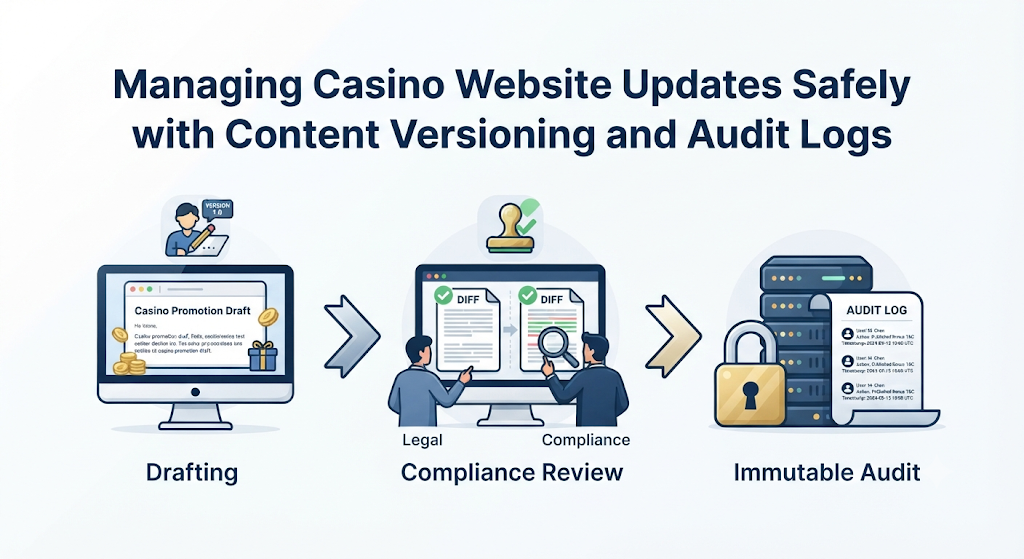
- Drafting: Writers create or modify copy inside an isolated draft or staging branch.
- Compliance Review: Legal and regulatory officers inspect a visual “diff” (a side-by-side comparison highlighting additions and deletions) against the current live version.
- Approval Gate: The CMS blocks publication until designated compliance roles attach digital sign-offs.
- Scheduled Release: Approved changes go live at a predetermined timestamp, automatically archiving the outgoing version.
Point-in-Time Reconstruction
True version control goes beyond keeping a list of past edits. It enables point-in-time reconstruction—the ability to render an exact snapshot of any webpage, bonus term, or localized footer as it appeared on a specific date and hour. If a dispute arises over a tournament held three months prior, support and legal teams can retrieve the exact HTML or structured JSON payload served during that window.
Designing an Immutable Audit Trail
While version control manages how content evolves, an audit trail provides a tamper-evident record of who changed it, when it happened, and why. For an audit log to hold up during regulatory inquiries or legal proceedings, it must be append-only and immutable—meaning even system administrators cannot alter or delete historical entries.
| Audit Log Attribute | Operational Purpose | Compliance Value |
|---|---|---|
| User ID & Role | Identifies the exact staff member or API service account that initiated the edit. | Enforces accountability and verifies whether the user had authorization to modify restricted text. |
| UTC Timestamp | Records the exact creation, approval, and publication times in Coordinated Universal Time. | Aligns website content states with player transaction logs, deposits, and bet timestamps. |
| Before-and-After Diff | Stores the exact text or configuration state prior to and immediately following the change. | Eliminates ambiguity during dispute resolution by showing precise wording alterations. |
| Approval Metadata | Logs the identity of the compliance reviewer and timestamp of sign-off prior to publishing. | Proves adherence to internal four-eyes review policies required by licensing bodies. |
| Locale & Domain Scope | Specifies which regional domain, language variant, or player segment received the update. | Confirms that jurisdiction-specific legal disclosures remained intact across multi-brand setups. |
Practical Architecture: Headless CMS vs. Git-Backed Workflows
Casino operators typically manage high-volume content through two primary technical architectures, each offering distinct advantages for versioning and auditing.
Enterprise Headless CMS
Modern casino platforms frequently rely on headless CMS solutions that deliver content via APIs to web and mobile apps. When configured for regulated environments, a headless CMS stores content as structured fields (e.g., separate fields for bonus_amount, wagering_multiplier, and expiry_days). Every save action generates a new version ID. By streaming CMS webhook events into a write-once storage bucket (such as AWS S3 with Object Lock), operators create an external, unalterable compliance archive independent of the CMS interface.
Git-Backed Content Repositories
For high-stakes static pages—such as Master Terms and Conditions, Privacy Policies, and Responsible Gambling Charters—many technical teams store content as Markdown or JSON files inside a Git repository. Every edit requires a Pull Request (PR). Git natively enforces cryptographic commit hashes, line-by-line blame tracking, and mandatory reviewer approvals before changes merge into the production branch.
Preventing Common Operational Blind Spots
Even platforms with basic CMS revision history often encounter gaps when audited closely. Addressing these blind spots strengthens overall platform integrity:
- Shared Login Credentials: Audit trails lose legal credibility if multiple editors log in under a generic “admin” account. Enforce Single Sign-On (SSO) with individual user attribution and Role-Based Access Control (RBAC).
- Untracked Third-Party Widgets: Banners, jackpot tickers, and promotional pop-ups injected via third-party marketing scripts often bypass the primary CMS. Ensure all dynamic overlays either pull from versioned endpoints or log their own display states.
- Silent Media Replacements: Swapping an image file that contains promotional text (such as a hero banner advertising free spins) without changing the filename can overwrite the visual record. Treat promotional graphics as versioned assets with unique hashes.
- Insufficient Retention Periods: Deleting revision logs after 30 or 90 days leaves operators exposed, as regulatory investigations and player chargeback disputes frequently surface months or years after an event. Align log retention schedules with licensing mandates—typically five to seven years.
Frequently Asked Questions
How does version control help resolve player bonus disputes?
When a player claims promotional terms were different at the time they opted in, version control allows the operator to cross-reference the player’s opt-in timestamp against the exact version of the terms active at that second, providing objective proof for internal dispute teams or Alternative Dispute Resolution (ADR) bodies.
What is the difference between CMS revision history and an immutable audit trail?
Standard CMS revision history lets editors undo mistakes or restore older drafts, and administrators can often purge or alter those revisions. An immutable audit trail is a locked, append-only security and compliance record that tracks every action—including approvals, failed edits, and deletions—without allowing anyone to modify the log history.
Which casino website pages require the strictest version tracking?
General Terms and Conditions, bonus and promotional rules, payment and withdrawal policy pages, RTP disclosures, privacy policies, and responsible gambling resources require the highest level of tracking and mandatory compliance sign-off.
How long should casino operators retain content audit logs?
Retention requirements vary by licensing jurisdiction, but most tier-one regulators require operators to maintain operational, transactional, and compliance records for at least five years following the end of a customer relationship or the expiration of a promotion.
Can automated workflows block non-compliant content from going live?
Yes. Modern publishing pipelines can run automated validation checks before deployment—scanning drafts for prohibited phrases (such as “risk-free”), verifying the presence of mandatory 18+ or 21+ disclaimers, and blocking publication if a compliance officer has not digitally approved the diff.
Conclusion
Fast-moving promotional calendars and strict licensing rules do not have to slow down your publishing workflow. By routing every copy update through staged approvals, attributing edits to individual accounts, and archiving historical snapshots automatically, casino operators gain full control over their digital storefront. Good content governance lets marketing teams ship localized campaigns at speed while giving legal and compliance officers complete visibility into every live page.
