Running an online casino review or iGaming affiliate platform starts simply enough. With twenty operator reviews and a handful of welcome offers, a standard WordPress setup with basic page templates handles the workload without friction.
The cracks appear when that library scales to hundreds of brands across multiple regulated markets. Suddenly, a single operator changes its wagering requirement from 35x to 40x, updates its minimum deposit, or pauses operations in a specific jurisdiction. If that bonus text is hardcoded inside fifty different comparison articles, blog posts, and top lists, updating it manually turns into an operational bottleneck—and a compliance liability.
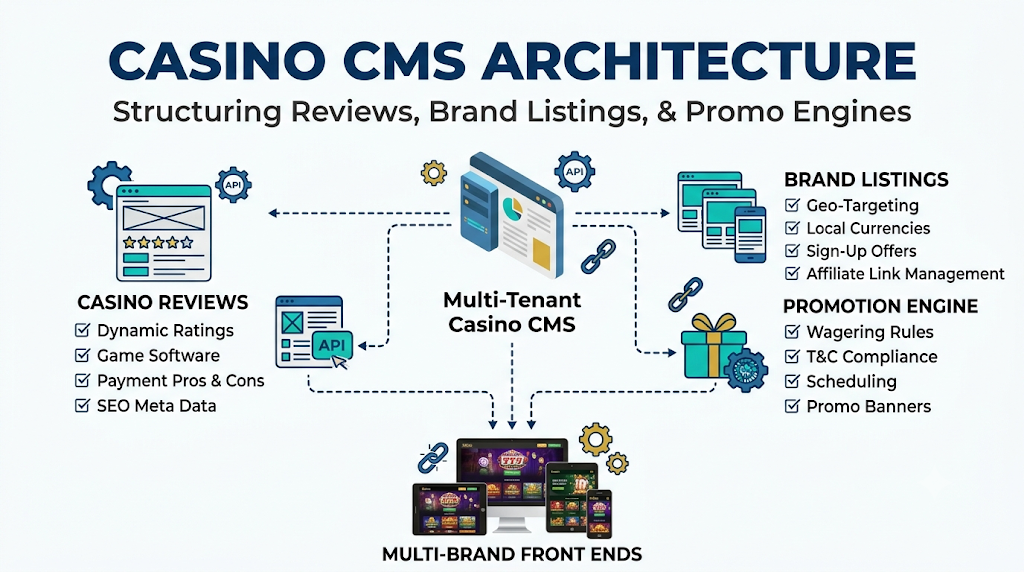
Solving this problem requires moving away from flat, page-based publishing toward a decoupled, modular Casino CMS Architecture. By separating static editorial prose from structured casino entities, dynamic bonus feeds, and strict approval workflows, iGaming publishers can scale content production while keeping commercial data accurate across every page.
Why Monolithic Page Builders Fail iGaming Publishers
Traditional content management systems treat a webpage as a single block of rich text. While this works well for standard news sites or personal blogs, casino publishing relies on interconnected data points that change independently of the surrounding commentary.
When editorial prose, brand metadata, and promotional terms live inside the same post body, three recurring failures emerge:
- Data Drift and Compliance Risks: Gambling regulators—such as the UK Gambling Commission (UKGC) and state-level authorities in the US—enforce strict rules around transparent bonus terms and significant conditions. When outdated wagering rules linger on older guide pages, publishers risk regulatory penalties and affiliate program terminations.
- Editorial Bottlenecks: Writers cannot focus on testing games or writing analysis if they spend half their week hunting down expired promo codes across legacy URLs.
- Rigid Presentation Layers: Hardcoded HTML tables and shortcodes make it difficult to reuse the same casino rating or payment method list across mobile views, comparison widgets, and localized landing pages.
The Four Pillars of a Modular Casino CMS
To eliminate manual duplication, modern iGaming platforms divide their content model into four distinct layers. Each layer has its own database schema, update frequency, and ownership rules.
| Architectural Layer | What It Stores | Update Frequency | Primary Owner |
|---|---|---|---|
| 1. Editorial Content | Guides, game reviews, strategy articles, news, and subjective opinions | Low to Medium (periodic refreshes) | Writers & Content Editors |
| 2. Casino Listings (Entities) | Core brand profiles, licenses, supported currencies, payment methods, and software providers | Low (changes only when brand infrastructure shifts) | Data Analysts / Operations |
| 3. Bonus & Offer Engine | Welcome packages, wagering requirements, promo codes, expiry dates, and geo-targeted T&Cs | High (weekly or daily adjustments) | Affiliate Managers / Commercial Team |
| 4. Editorial Workflows | User roles, version history, compliance sign-offs, and scheduled publishing states | Continuous (active on every edit) | Managing Editors & Legal Reviewers |
1. Editorial Content Layer
The editorial layer holds human-written narrative: how a slot game plays, what makes a live dealer lobby stand out, or how to evaluate payout speeds. Instead of typing a casino’s current welcome bonus directly into a paragraph, the writer inserts a dynamic reference token or structured block pointing to the brand’s unique ID. The narrative remains clean, readable, and focused on player experience.
2. Casino Listings (Core Brand Entities)
A casino listing acts as the single source of truth for a gambling operator. Rather than recreating a brand’s profile inside every article, the CMS stores the casino as a standalone structured object containing:
- Licensing and Jurisdiction Data: Active license numbers, issuing authorities, and restricted country lists.
- Banking Attributes: Deposit and withdrawal methods, payout processing times, and currency support.
- Product Catalog Metrics: Game studio partnerships, live casino availability, and mobile app compatibility.
- Platform Scores: Granular ratings (e.g., UX, customer support, payout reliability) that automatically calculate an overall brand score.
When an operator adds Apple Pay or secures a new provincial license, updating the central entity immediately reflects across every comparison table and review page referencing that brand.
3. Bonus and Promotion Engine
Promotions are the most volatile element in iGaming. Treating bonuses as child objects linked to a parent casino entity—rather than static text—allows commercial teams to manage offers without touching editorial articles.
A well-structured bonus schema separates the headline offer from its fine print:
- Offer Mechanics: Match percentage, maximum bonus amount, free spins count, and eligible games.
- Wagering Conditions: Rollover multipliers (e.g., bonus-only vs. deposit + bonus), maximum bet limits, and game contribution weights.
- Geo-Targeting Rules: Country-specific variations so a visitor from Ontario sees local CAD terms while a visitor from the UK sees GBP terms and mandatory responsible gambling disclaimers.
- Lifecycle States: Active, expired, or paused statuses that automatically hide or replace unavailable deals on the front end.
4. Editorial and Compliance Workflows
Separating data models only works if human permissions match that separation. In a flat CMS, anyone with contributor access might accidentally alter an affiliate tracking link or delete a mandatory terms disclosure.
Role-based access control (RBAC) enforces clear boundaries:
- Writers draft and edit prose blocks, select which casino entities to feature, and propose rating adjustments.
- Affiliate Managers update bonus figures, tracking URLs, and geo-restrictions inside the offer engine without gaining edit access to editorial copy.
- Compliance & Managing Editors review diffs across both content and data layers before approving a page for live publication.
How Data Flows From Entry to Front-End Rendering
In practice, decoupling these layers works much like a headless or hybrid CMS architecture (whether built on custom Strapi/Contentful setups or heavily customized WordPress environments using Advanced Custom Fields and custom database tables).
- Entity Creation: An operations specialist creates the master profile for Brand X, logging its license details, payment options, and base ratings.
- Offer Attachment: An affiliate manager attaches two active bonus objects to Brand X—one tailored for European markets and another for North American traffic.
- Article Assembly: A writer drafts a guide on fast-payout casinos. Where a recommendation box is needed, the writer drops in a modular “Casino Card” block and selects Brand X from a dropdown menu.
- Dynamic Assembly at Render Time: When a reader loads the guide, the front end queries the editorial text, pulls Brand X’s current rating from the listing database, fetches the visitor’s region-appropriate bonus from the offer engine, and renders a unified card complete with up-to-date terms.
Practical Challenges When Transitioning to a Modular Setup
Moving away from traditional page-based publishing introduces technical and operational trade-offs that teams need to plan for early.
- Preview Complexity: Because a single page pulls data from multiple tables and geo-rules, editors need reliable preview tools to see how an article looks for users in different countries before hitting publish.
- SEO and Internal Linking: Dynamic widgets and client-side rendering can hide important review text or comparison data from search engine crawlers if not rendered server-side (SSR) or statically generated (SSG). All structured listing data must output clean, crawlable HTML.
- Over-Engineering Small Sites: Building a multi-layer relational schema with automated API feeds makes little sense for a niche site covering fifteen local operators. Modular architecture pays off once a platform manages dozens of brands, multiple authors, or multi-region traffic.
Frequently Asked Questions
Can you build a modular casino CMS on WordPress, or does it require a custom headless CMS?
Both approaches work. WordPress can support separated architecture by using Custom Post Types (CPTs) for casinos and bonuses, relational fields to link them, and strict user role plugins. However, platforms managing high traffic across multiple regions often prefer headless systems like Sanity, Strapi, or Contentful paired with Next.js for faster front-end rendering and cleaner API-driven data distribution.
How does separating bonus data help with gambling advertising compliance?
Regulators require promotional terms—such as wagering requirements, minimum deposits, and time limits—to appear clearly alongside any advertised offer. Storing terms in dedicated database fields ensures they cannot be accidentally deleted during copy edits and allows compliance teams to update disclosures globally in seconds.
What happens to SEO if casino comparison tables are loaded dynamically?
If comparison tables rely purely on client-side JavaScript after page load, search engines may fail to index the brand names, ratings, and structured data. Using server-side rendering (SSR) or incremental static regeneration (ISR) ensures that dynamic database entries are compiled into standard HTML before reaching the browser or search crawler.
How should historical bonus changes be tracked in the CMS?
A robust casino CMS maintains audit logs and version snapshots whenever a bonus or rating field changes. Keeping timestamped records helps editors verify when an operator altered its terms and protects publishers during affiliate disputes or regulatory audits.
Bringing Structure to Scale
The strength of a casino publishing platform rarely comes down to how fast writers can produce new pages—it comes down to how reliably the platform maintains the pages it already has. Separating editorial storytelling from structured brand listings, volatile bonus feeds, and permissioned workflows turns a fragile collection of articles into a maintainable knowledge system. When data lives in one place and renders everywhere it is needed, teams spend less time fixing broken terms and more time producing trustworthy analysis for readers.
