Introduction
Entering the online gaming industry is a bit like opening a luxury hotel on a quiet side street. You can spend a fortune handing out flyers at the airport, but the moment your marketing budget runs dry, the visitors stop arriving. Many new and growing platforms make the mistake of relying entirely on expensive pay-per-click campaigns and high-cost media buying. While these methods offer quick visibility, they come with a major catch: fierce competition drives ad costs sky-high, and strict advertising regulations across different countries make running digital ads an ongoing legal headache.
When player acquisition costs spiral out of control, platforms look for sustainable alternatives. That is where casino organic growth strategies change the game. Organic marketing focuses on earning your audience’s attention through trust, authority, and high visibility on search engines.
However, mastering organic growth in the iGaming sector is notoriously difficult. Search engines look closely at gaming sites to ensure they provide safe, accurate, and helpful information. If your strategy lacks depth, technical polish, or player focus, search engines will ignore your platform entirely.
This guide breaks down how to build a powerful organic growth engine for your platform, balancing expert-level industry practices with simple, clear language that anyone can follow.
What Is Casino Organic Growth?
Casino organic growth is the practice of increasing your gaming platform’s visibility, player registrations, and brand loyalty through non-paid, earned channels.
Professional term -> Simple meaning -> Why it matters -> Example
- Organic Traffic: Visitors who land on your website naturally through search engine results pages (SERPs) rather than clicking a sponsored advertisement. It matters because organic visitors generally trust your platform more than paid ad viewers. For example, a player searching for “best low-wagering slot bonuses” and finding your helpful guide is far more likely to stick around than someone who clicked a flashy banner ad by accident.
- Domain Authority (DA): A search engine ranking score that predicts how likely a website is to rank on search engine result pages. It matters because higher authority means search engines trust your site more. For example, an established gaming review site with a high DA will rank on page one for popular slot reviews, while a brand-new, poorly optimized site will remain buried on page five.
- SERP Visibility: How easily and prominently your website appears when someone searches for terms related to your industry. It matters because visibility directly drives traffic. For example, ranking in the top three spots for “live dealer blackjack strategies” captures the vast majority of clicks from interested players.
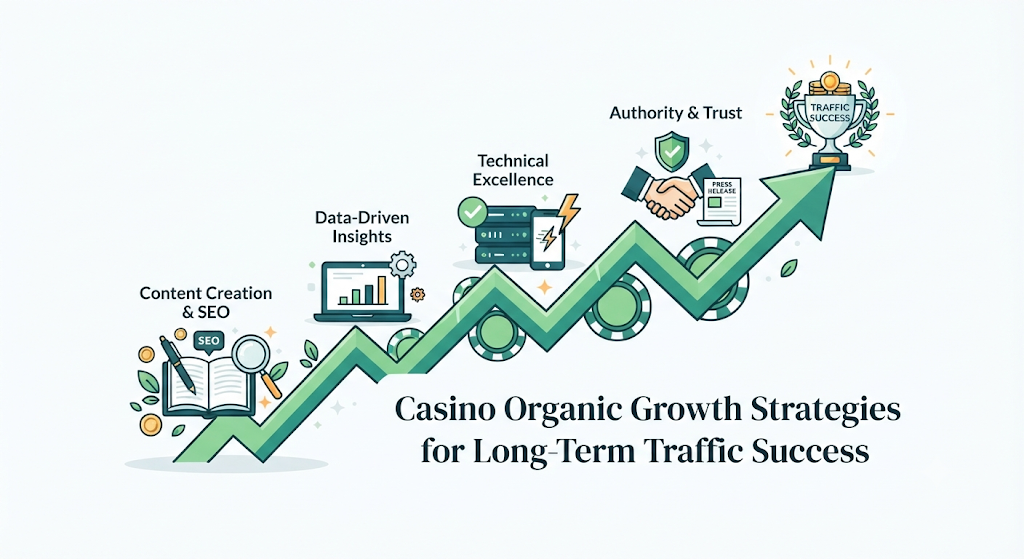
Organic growth is not about quick tricks or shortcuts. It is a long-term strategy built on three main pillars: technical website health, useful content that answers player questions, and a trustworthy reputation across the web.
How Casino Organic Growth Works
Building an organic growth engine requires a coordinated approach across several different operational departments. It is not just the job of the marketing team; your developers, content writers, compliance officers, and customer support staff all play a vital role.
[Technical SEO & Site Speed] ➔ [Helpful & Compliant Content] ➔ [Trust & Off-Page Signals] ➔ [Player Retention & Engagement]
1. Technical Foundation
Before search engines can recommend your gaming platform, their automated programs (called web crawlers or bots) must be able to explore and understand your website easily. A slow-loading casino lobby, broken mobile links, or messy site structure will cause search engines to give up and rank your competitors instead.
2. Content Architecture
Players rarely type a brand-new casino name into Google unless they already know it. Instead, they search for answers, rules, comparisons, and game guides. By publishing clear, accurate guides on game rules, payout percentages, and bankroll management, you capture search traffic from curious beginners who eventually become registered players.
3. Authority and Link Building
Search engines measure your site’s credibility by seeing how many other reputable websites link back to your content. In the iGaming industry, earning these links organically requires publishing unique research, genuinely useful tools, or expert commentaries that industry blogs and news sites want to reference.
Why Organic Growth Matters for Gaming Platforms
Paid ads are fast, but they have major limitations in the regulated gaming sector. Organic growth solves several core business challenges that paid marketing simply cannot touch.
Cost Control and Sustainability
In competitive gaming markets, the cost to acquire a single depositing player (known as Customer Acquisition Cost or CAC) through paid ads can be staggering. If bidding prices spike during major sporting events or holiday seasons, paid campaigns can quickly become unprofitable. Organic growth scales efficiently; once an article or landing page ranks well on search engines, it continues bringing in free player traffic 24 hours a day without requiring continuous ad spend.
Trust and Credibility
Modern players are sophisticated. Many use ad blockers and automatically scroll past sponsored search results. When a player finds your site organically because you published a genuinely helpful guide on how roulette odds work, they view your platform as an authority rather than a salesman. This initial trust translates directly into higher registration and deposit conversion rates.
Regulatory Resilience
Advertising rules for gambling platforms change constantly across different states and countries. Platforms that rely 100% on paid ads face constant risk of ad accounts getting suspended or banned due to shifting policy updates. While SEO and organic content must also comply with local advertising laws, an owned audience and steady search presence provide a much more stable long-term business asset.
Important Factors to Understand
To build a successful organic growth strategy, you must master several core elements that influence how search engines and players interact with your brand.
1. Search Intent Alignment
Search intent is the underlying reason behind a user’s search query. If someone searches for “how to play baccarat,” they want an educational guide, not a promotional pop-up telling them to deposit money immediately. If your page tries to sell them a bonus instead of teaching them the rules, they will bounce away instantly, signaling to search engines that your page is unhelpful.
2. Content Depth and Accuracy
Thin, generic articles that simply repeat basic facts will never rank well. Search engines reward comprehensive content that fully answers a user’s questions. For a casino platform, this means going beyond surface-level game lists to explain volatility, return-to-player (RTP) mechanics, and responsible gaming tools in plain, accessible English.
3. User Experience (UX) and Mobile Optimization
A massive percentage of online gaming traffic comes from smartphones and tablets. If your casino lobby takes more than three seconds to load on a mobile device, or if buttons are too small to tap easily, players will leave. Clean navigation, fast loading times, and intuitive layout design are fundamental organic ranking factors.
Detailed Explanation of Core Organic Strategies
Search Engine Optimization (SEO) for Gaming
SEO is the backbone of organic growth. For an online casino or gaming portal, SEO involves optimizing your site architecture, keyword targeting, and metadata so search engines understand your value.
- Keyword Research: Finding out what your target audience is searching for. Instead of only targeting broad, hyper-competitive terms like “online casino,” smart platforms target long-tail search queries like “best low minimum deposit live roulette sites.”
- On-Page Optimization: Ensuring that every page has clear headings (H2, H3), descriptive title tags, and natural keyword integration that helps search bots index your content accurately.
Content Marketing That Educates and Converts
Content marketing in the gaming space must balance entertainment with education. Players appreciate platforms that help them become smarter, safer bettors.
- Game Strategy Guides: Break down complex table games like poker, blackjack, and craps into easy-to-digest rules and basic strategies.
- Industry Insights & Transparency: Publish transparent guides explaining how random number generators (RNGs) work, how payout audits are conducted, and why licensing matters. This builds immense brand trust.
Technical Performance and Core Web Vitals
Search engines measure your website’s performance using metrics known as Core Web Vitals. These track how fast your pages load, how quickly they respond when a user taps a button, and whether elements jump around while loading. A technically sound website keeps players engaged longer and signals high quality to search engine algorithms.
Practical Examples
Example 1: The New Game Guide Strategy
- The Situation: A growing gaming portal wants to attract organic traffic for newly released slot games without paying for Google Ads.
- The Action: Instead of waiting for users to search for their brand name, the team publishes an in-depth, unbiased review of an upcoming slot release two weeks before it launches, detailing its bonus mechanics, volatility rating, and RTP percentage.
- The Result: When eager players search for details about the new game prior to release, the portal’s article appears at the top of search results, driving thousands of targeted organic visitors to the site who then explore other platform offerings.
Example 2: Simplifying Complex Bonus Terms
- The Situation: Players frequently complain that promotional wagering requirements are too confusing, leading to high drop-off rates and bad reviews.
- The Action: The platform creates a clear, jargon-free guide titled “How Wagering Requirements Actually Work,” using a simple coffee-shop analogy to explain rollover math.
- The Result: Players finally understand the terms, feel respected by the platform’s transparency, and register accounts with higher confidence and lower frustration.
Real-World Considerations
Implementing organic growth strategies requires patience and realistic operational planning. Unlike paid advertising, which can drive traffic within minutes of launching a campaign, organic growth takes time.
- Time Horizon: Building domain authority and ranking competitive keywords typically takes 6 to 18 months of consistent, high-quality publishing and technical optimization.
- Resource Allocation: Organic growth is not free; it requires skilled content creators, SEO specialists, and web developers. However, while upfront costs are real, the long-term return on investment (ROI) usually far surpasses paid advertising once rankings stabilize.
- Compliance and Localization: Gaming regulations vary wildly by jurisdiction. Your organic growth strategy must be flexible enough to tailor content to specific regional laws, age-verification rules, and responsible gambling mandates.
Common Mistakes
| What People Do | Why They Do It | Why It Causes Problems | What They Should Do Instead |
| Keyword Stuffing | Hoping to trick search engines into ranking them higher by repeating keywords constantly. | Search engines detect unnatural repetition and penalize the site, ruining its search visibility. | Integrate primary and secondary keywords naturally where they genuinely help the reader. |
| Ignoring Mobile UX | Focusing entirely on desktop monitors during the website design phase. | Over 70% of modern players use mobile devices; poor mobile layouts drive users away instantly. | Design and test all website features and content strictly for mobile-first responsiveness. |
| Publishing Thin Content | Pumping out hundreds of short, AI-generated pages to cover every possible game keyword. | Search engines flag low-quality, repetitive content as spam, harming overall domain trust. | Focus on fewer, highly detailed, expert-reviewed guides that genuinely help the player. |
| Neglecting Technical SEO | Assuming great content alone is enough to overcome a slow, broken website structure. | If search bots cannot crawl your pages efficiently, even great content will never get indexed or ranked. | Regularly audit site speed, fix broken links, and optimize Core Web Vitals. |
Risks and Limitations
Every marketing strategy comes with inherent risks that operators must monitor and manage carefully.
Algorithm Updates
Search engine algorithms change frequently. A sudden update can shift your rankings overnight, dropping a page from position one to position ten.
- How to reduce it: Never rely on a single trick or shortcut. Focus on building genuinely useful, high-quality content and a diversified traffic portfolio across multiple search queries and channels.
Regulatory and Compliance Shifts
Advertising standards and online gaming laws can change with little warning in various markets, potentially rendering certain content topics non-compliant.
- How to reduce it: Maintain close communication with legal and compliance teams. Review and update older content regularly to ensure it reflects current licensing rules and responsible gambling standards.
Decision-Making Framework
Use this simple framework to evaluate whether your platform is ready to scale its organic growth efforts:
- Assess Current Technical Health: Run a complete audit of your site speed, mobile responsiveness, and indexing status. Fix any critical errors before launching new content campaigns.
- Define Your Audience and Intent: Identify what your target players are actually searching for (e.g., game rules, payout guides, strategy tips) rather than just what you want to sell them.
- Map Out Content Gaps: Compare your existing articles against top competitors to find topics, questions, and guides that nobody else is explaining clearly.
- Establish Quality Guidelines: Ensure every piece of content is fact-checked, easy to read (targeting our 80–90% readability goal), and compliant with local industry regulations.
- Monitor and Iterate: Track organic traffic growth, keyword rankings, and user engagement metrics monthly to refine your strategy and double down on what works.
Key Terms
- Algorithmic Update: A major adjustment to a search engine’s ranking formula that changes how websites are scored and ordered in search results.
- Core Web Vitals: Specific performance metrics established by search engines to measure page loading speed, visual stability, and interactivity.
- Indexation: The process by which search engine bots discover, analyze, and store your web pages in their database so they can appear in search results.
- Long-Tail Keywords: Specific, multi-word search phrases (e.g., “how to manage bankroll in online baccarat”) that have lower search volume but much higher conversion intent.
- Metadata: Hidden HTML elements like title tags and meta descriptions that tell search engines and users what a specific webpage is about.
- Return to Player (RTP): A theoretical percentage calculated over millions of spins that indicates how much money a casino game pays back to players over time.
- SERP: Search Engine Results Page — the page a user sees after typing a query into a search engine.
- Volatility: A measure of how often and how much a casino game pays out, distinguishing between frequent small wins and rare large wins.
FAQs
What is the difference between organic growth and paid acquisition for a casino?
Organic growth relies on earned search traffic, helpful content, and SEO to attract players naturally over time without ongoing ad spend. Paid acquisition involves paying platforms like Google or social media networks to display ads that drive immediate, but temporary, traffic.
How long does it take for casino SEO to show results?
Because the online gaming industry is intensely competitive, building sufficient domain authority and search visibility typically takes between 6 to 18 months of consistent, high-quality publishing and technical optimization.
Why is mobile optimization so important for casino organic growth?
The vast majority of modern players access gaming platforms and read reviews on their smartphones. If your site loads slowly or is difficult to navigate on mobile devices, search engines will lower your rankings, and players will immediately leave for a competitor.
Can small casino platforms compete with giant brands organically?
Yes. While big brands dominate broad terms like “online casino,” smaller platforms can win significant organic traffic by targeting specific niche queries, such as guides for specific game variations, payment method comparisons, or beginner-friendly strategy tips.
What role does responsible gaming play in organic growth?
Demonstrating a genuine commitment to player safety and responsible gambling builds vital brand trust. Search engines and players alike favor transparent platforms that provide clear self-exclusion tools, deposit limits, and educational resources.
How often should old casino content be updated?
You should audit and update your key articles at least every 6 to 12 months. Keeping game rules, bonus terms, and technical information accurate ensures your content remains helpful to players and favored by search engine algorithms.
Conclusion
Building a successful online gaming platform requires more than flashy games and attractive bonuses. Relying solely on paid ads is expensive, volatile, and leaves your business vulnerable to rising acquisition costs and shifting advertising rules.
By investing in robust casino organic growth strategies—such as a rock-solid technical foundation, transparent and educational content, and a player-first user experience—you build a lasting digital asset. Organic growth takes time and patience, but the result is a steady, self-sustaining stream of engaged players who trust your brand for the long run.
