Anyone who has ever managed an online casino directory, compliance database, or iGaming analytics platform knows how quickly unorganized spreadsheets fall apart. A single gaming brand might operate under three different regional licenses, accept forty payment methods that vary by country, and run welcome bonuses with shifting wagering requirements. When all of that information lives in flat text files or disconnected tables, updates turn into a manual nightmare and users end up seeing outdated or contradictory details.
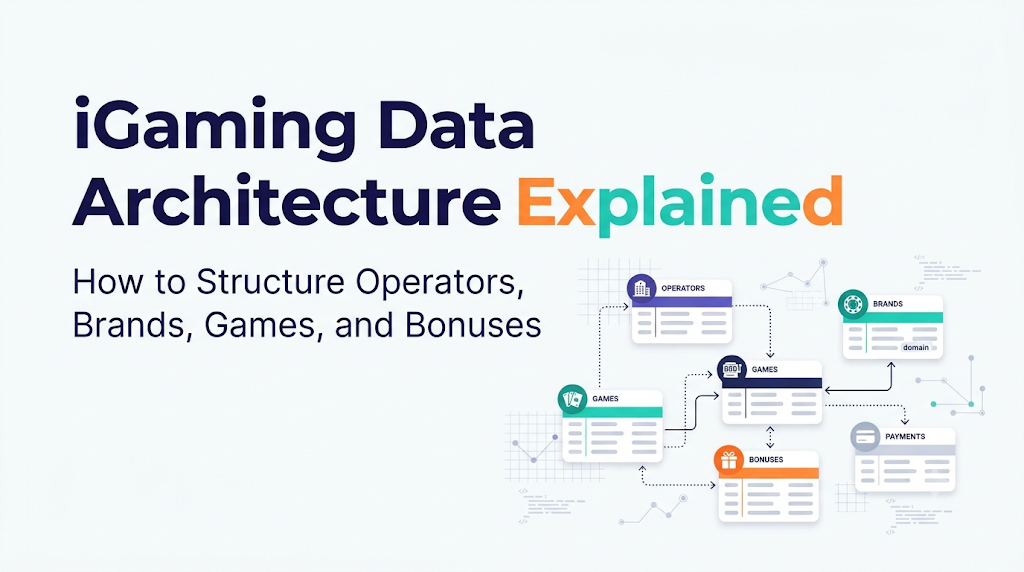
Building structured casino data models solves this problem by separating core iGaming components into distinct, linked entities. Instead of treating a casino listing as one giant block of text, a relational data model breaks the ecosystem down into five foundational pillars: Operators, Casinos, Games, Payments, and Bonuses. Understanding how these entities connect—and where their rules overlap—allows data architects, product managers, and iGaming publishers to deliver accurate, filterable, and scalable information.
Why Flat Data Fails in the iGaming Ecosystem
In simpler industries, a one-to-one data structure works fine. A retail product has a name, a price, a SKU, and a description. Online gambling platforms rarely follow neat one-to-one rules because regulatory boundaries and third-party integrations change the product depending on where a player logs in.
Consider three common points of failure when platforms rely on flat or poorly structured data:
- Jurisdictional Overrides: An online casino might accept players from both Canada and Germany, yet offer completely different game catalogs, deposit limits, and bonus terms in each market due to local licensing rules.
- Shared Corporate Ownership: Many player-facing casino brands belong to the same parent company. If a corporate operator updates its license number, responsible gambling policy, or ownership details, flat databases force editors to update dozens of individual brand pages one by one.
- Dynamic Promotional Rules: A welcome package is rarely just a single number. It often includes tiered deposit matches, free spins tied to specific slot titles, game contribution percentages, and expiration windows. Storing this as a plain text string makes automated comparison or filtering impossible.
A well-designed schema eliminates these bottlenecks by establishing clear parent-child and many-to-many relationships across the entire platform.
The Five Core Entities of a Casino Data Architecture
To capture how an online casino actually functions behind the scenes, a structured model organizes data into five primary tables or object collections. Each entity holds only the attributes that directly belong to it, relying on unique identifiers (primary and foreign keys) to connect with the rest of the system.
1. Operators (The Corporate & Licensing Layer)
At the top of the hierarchy sits the Operator—the legal business entity that owns, manages, and holds regulatory accountability for one or more gambling websites. Separating the corporate operator from the consumer-facing brand prevents duplicate compliance records and clarifies who is actually running the platform.
- Core Attributes:
operator_id, legal registered name, headquarters jurisdiction, parent holding company, corporate registration number, and customer support infrastructure. - Licensing Sub-Entity: Because a single operator often holds multiple regulatory approvals (such as licenses from the Malta Gaming Authority, UK Gambling Commission, or Alcohol and Gaming Commission of Ontario), licensing works best as a linked child table containing
license_id,regulator_name,license_number,status(active, suspended, revoked), andcovered_jurisdictions.
2. Casinos (The Player-Facing Brands)
A Casino represents the specific website, mobile app, or storefront that players interact with. One operator may run ten different casino brands, each tailored to a distinct theme, language, or regional market.
- Core Attributes:
casino_id,operator_id(foreign key), brand name, primary domain URL, launch year, supported interface languages, customer support channels, and responsible gambling tools (such as self-exclusion options, deposit caps, and reality checks). - Localization & Market Availability: Rather than listing restricted countries as a comma-separated text block, a clean model uses a junction table (
casino_jurisdictions) that maps eachcasino_idto specific country or state codes, along with localized URLs and applicable license IDs.
3. Games (The Content Catalog & Studio Layer)
Online casinos rarely build their own games; instead, they aggregate titles from third-party software studios and game aggregators. Modeling Games properly requires separating the game’s universal traits from how an individual casino configures it.
- Core Attributes:
game_id, title,provider_id(linking to the software studio), game category (slots, table games, live dealer, crash games), theoretical Return to Player (RTP), volatility rating, minimum/maximum bet limits, and release date. - Casino-Specific Game Configurations: Some software providers allow operators to select from multiple certified RTP versions of the same slot. A junction table (
casino_games) connectscasino_idandgame_idwhile storing local overrides, such as the active RTP percentage at that specific casino or whether the game is restricted in certain regions.
4. Payments (Banking Rails, Currencies & Limits)
Payment processing is one of the most variable parts of any iGaming platform. A method available for deposits may not support withdrawals, and transaction limits frequently depend on both the currency and the user’s country.
- Core Attributes:
payment_method_id, method name (e.g., Interac, PayPal, Visa, SEPA, Bitcoin), payment category (e-wallet, bank transfer, card, cryptocurrency), and supported fiat or crypto currencies. - Transaction Rule Mapping: Linking a payment method to a casino requires a relational bridge (
casino_payments) that defines direction (deposit_supported,withdrawal_supported), minimum and maximum transaction limits, processing time windows, and any operator-imposed fees.
5. Bonuses (Promotional Mechanics & Wagering Logic)
Bonuses carry the highest complexity because they combine marketing figures with strict mathematical conditions. Treating a bonus as structured data rather than promotional copy allows users and systems to evaluate its true terms accurately.
- Core Attributes:
bonus_id,casino_id, bonus type (no-deposit, first-deposit match, reload, cashback, free spins), match percentage, maximum bonus value, minimum qualifying deposit, and promo code (if required). - Wagering & Eligibility Rules: A dedicated rules structure tracks
wagering_multiplier(e.g., 35x), whether the rollover applies to the bonus amount only or deposit plus bonus, maximum bet limits while wagering, expiration period in days, and game-type weighting (e.g., slots contributing 100% while blackjack contributes 10%).
Entity Relationship Overview
Understanding how these five pillars interact becomes much clearer when mapped side by side. The table below outlines the relationship types and primary linking keys across a standard iGaming database.
| Core Entity | Relationship to Casino | Key Linking Identifiers | Primary Role in the Schema |
| Operators | One-to-Many (1:N) | operator_id | Stores corporate ownership, legal addresses, and regulatory licenses. |
| Casinos | Central Hub Entity | casino_id, operator_id | Defines brand identity, domain details, language support, and safety tools. |
| Games | Many-to-Many (M:N) | game_id, provider_id | Catalogs software titles, studio origins, mechanics, and baseline RTPs. |
| Payments | Many-to-Many (M:N) | payment_method_id, currency_code | Tracks deposit/withdrawal availability, transaction limits, and processing speeds. |
| Bonuses | One-to-Many (1:N) | bonus_id, casino_id | Structures promotional offers, rollover math, validity windows, and game weights. |
Handling Complex Edge Cases in iGaming Schemas
Even a clean five-entity diagram will encounter real-world complications once live data enters the system. Designing for these edge cases early prevents painful database migrations later.
Multi-Tiered Welcome Packages
Many casinos split their welcome offer across the first three or four deposits (for example, 100% up to $200 on the first deposit, followed by 50% up to $300 on the second). Instead of creating disconnected bonus records that confuse users, group them under a parent campaign_id with a step_order integer. This preserves the sequence of the offer while keeping each deposit tier independently queryable.
Geo-Targeted Rules and Currency Variants
A single bonus or payment method often changes values depending on currency. For instance, a minimum deposit might be €10 in Europe, C$15 in Canada, and R$50 in Brazil. Rather than hardcoding a single currency field onto the bonus or payment table, attach a child currency_amounts table that stores localized values keyed by ISO currency codes (EUR, CAD, BRL).
Data Freshness, Audits, and Change Logs
Gambling terms, payment availability, and active game counts shift constantly. Every core table benefits from standardized metadata fields:
last_verified_at(timestamp showing when an editor or automated feed confirmed the record)verification_source(e.g., official terms page, regulator registry, API feed)status(active,expired,pending_review,archived)
Tracking verification timestamps ensures that stale offers can be automatically flagged or hidden before they mislead readers.
Practical Applications for Publishers and Platforms
Structuring iGaming data properly is not just an exercise for backend engineers—it directly improves user experience, search visibility, and regulatory compliance across several business models:
- Dynamic Comparison and Filtering: When payments, games, and bonuses live in normalized tables, visitors can run multi-criteria queries—such as finding licensed casinos that accept a specific e-wallet, carry games from a chosen studio, and offer wagering requirements under 35x.
- Automated Regulatory Compliance: If a regulator suspends an operator’s license or updates advertising rules in a specific region, updating a single record in the
licensesorcasino_jurisdictionstable can immediately cascade across every affected brand page. - Programmatic Content Generation: Clean JSON or SQL schemas feed structured data markup (such as
FAQPageorOrganizationschema), comparison tables, and localized landing pages without manual copy-pasting. - Accurate Responsible Gambling Disclosures: Linking jurisdictional records directly to localized helpline numbers, minimum legal age thresholds (18+ vs. 21+), and mandatory regulatory disclaimers ensures every page displays accurate consumer protection notices for the visitor’s region.
Frequently Asked Questions (FAQs)
Should game providers be stored inside the Games table or as a separate entity?
Game providers (software studios) should always be stored in their own separate providers table and linked via a provider_id foreign key. Studios carry their own attributes—such as corporate headquarters, B2B supplier licenses, and acquisition history—that would be duplicated thousands of times if stored directly inside individual game rows.
How do you model white-label casinos versus independent operators?
In a white-label arrangement, one company provides the underlying platform, payment processing, and regulatory license, while a separate partner handles branding and marketing. You can model this accurately by adding a platform_provider_id alongside the license_holder_id on the casinos entity, distinguishing between the technical platform, the legal licensee, and the marketing brand.
What is the best way to store bonus wagering requirements for accurate comparisons?
Separate the numeric multiplier from the calculation basis. Store wagering_multiplier as a decimal or integer (e.g., 30) and pair it with a standardized enum field like wagering_basis (bonus_only, deposit_and_bonus, or free_spin_winnings). Mixing both pieces of information into a single text field prevents accurate mathematical sorting.
How often should structured casino data be audited or refreshed?
High-volatility entities like Bonuses and Payments should be verified at least weekly or synced directly via verified partner APIs, as promotional terms and banking processors change frequently. Core Operator and License records change less often and can typically be audited monthly or whenever a regulatory registry publishes an update.
Can a single database schema support both traditional fiat casinos and crypto-focused platforms?
Yes, provided that currencies and payment rails are decoupled from the core casinos table. By using standard ISO codes for fiat currencies alongside standardized ticker symbols for cryptocurrencies inside a unified currencies lookup table, the same schema can track minimum deposits, withdrawal caps, and bonus values across both models without structural changes.
Bringing Order to Complex iGaming Information
A reliable casino database depends on clear boundaries between corporate accountability, platform branding, game software, financial rails, and promotional terms. When Operators, Casinos, Games, Payments, and Bonuses each occupy their own well-defined structure—connected through disciplined relational keys and geo-aware rules—platforms avoid duplicate work, reduce factual errors, and give users transparent, verifiable data they can actually filter and compare.
