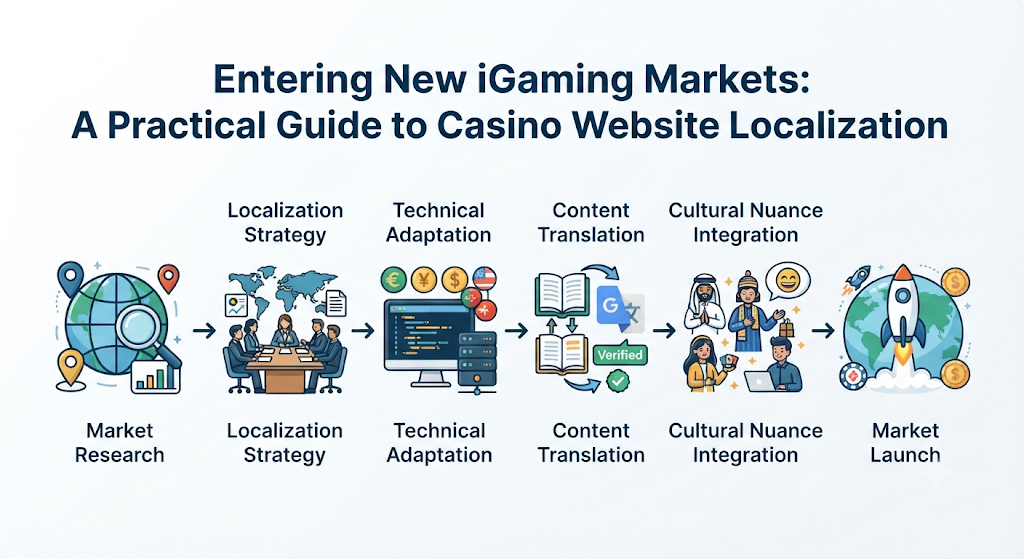
Launching an online casino platform across multiple countries involves far more than translating English menus into Spanish, German, or Japanese. A platform that feels intuitive to a player in Ontario can appear confusing, untrustworthy, or legally non-compliant to a player in Sweden or Brazil.
Casino website localization is the process of adapting an iGaming platform’s language, cultural tone, payment infrastructure, game catalog, and legal framework to match the expectations and laws of a specific jurisdiction. When executed well, localization removes friction from registration to withdrawal while keeping operators aligned with local gambling authorities.
Why Direct Translation Falls Short in iGaming
Translation converts words from one language to another; localization adapts the entire user experience so it feels native to a specific market. In online gambling, where players deposit real money and share sensitive identity documents, minor linguistic or cultural mismatches quickly erode trust.
Consider how different regions interact with betting terminology:
- Sportsbook and Odds Formats: A player in the United Kingdom expects fractional odds (such as 5/1), a user in continental Europe looks for decimal odds (6.00), and a bettor in the United States relies on American moneyline odds (+500).
- Table Game Vocabulary: Terms like “shoe,” “banker,” “push,” or “ante” do not always have direct equivalents across languages. Experienced localizers use established regional casino jargon rather than literal dictionary translations.
- Promotional Framing: Bonus structures and wagering requirements are interpreted differently depending on local habits. Phrases like “free spins” or “no-deposit bonus” often require specific legal qualifiers in regulated jurisdictions to avoid misleading advertising penalties.
Adapting Content and Game Libraries to Local Tastes
Player preferences vary sharply by geography, and a localized casino lobby reflects those regional habits rather than displaying a single global homepage.
Regional Game Preferences
Slot mechanics, table games, and live dealer formats perform differently across markets:
- European Markets: Players in countries like the UK, Sweden, and Germany tend to favor high-volatility video slots, classic roulette, and live blackjack streamed with native-speaking dealers.
- Asian Markets: Regions across East and Southeast Asia show strong engagement with baccarat, sic bo, dragon tiger, and arcade-style fishing games.
- Latin American Markets: Markets such as Brazil, Mexico, and Colombia see high interest in football-themed slots, crash games, and localized live game shows.
Cultural Nuances in Visuals and Messaging
Colors, symbols, and themes carry distinct meanings across cultures. Imagery associated with luck in one country—such as four-leaf clovers or horseshoes in Western Europe—may hold little meaning elsewhere, while symbols like the number 8 or red-and-gold palettes carry positive associations in many East Asian markets. Conversely, certain imagery, religious references, or humor styles can alienate players or violate local advertising standards.
Currency, Payment Methods, and Cashier Localization
A seamless cashier experience is one of the strongest predictors of player retention. Even if a site is written in a player’s native language, forcing them to deposit in a foreign currency introduces exchange fees and mental math that discourage transactions.
| Localization Layer | Standard Global Setup | Localized Market Setup |
|---|---|---|
| Display Currency | USD or EUR only | Local currency (e.g., BRL, CAD, SEK, JPY, INR) |
| Payment Rails | Visa, Mastercard, international e-wallets | Local instant bank transfers (e.g., PIX in Brazil, Interac in Canada, Trustly in Sweden) |
| Minimum/Maximum Limits | Fixed USD equivalents (e.g., $10.43 after conversion) | Clean, round local figures (e.g., R50orCA15) |
| Fee Transparency | Currency conversion handled by the player’s bank | Zero-conversion local processing with clear deposit timelines |
Local Payment Preferences
Payment infrastructure is deeply regional:
- Brazil: Instant payment networks like PIX dominate digital transactions, making local bank integration essential.
- Canada: Interac e-Transfer remains the preferred method for fast, familiar bank-to-merchant transfers.
- Nordic Countries: Open-banking solutions such as Trustly and Swish allow players to verify identity and deposit funds simultaneously through BankID.
- Germany and the Netherlands: Local banking tools like Sofort (Klarna) and iDEAL are standard expectations at checkout.
Navigating Regional Rules and Regulatory Compliance
Regulation is the strictest pillar of casino website localization. Operating in a regulated market requires hard-coding legal rules directly into the website’s architecture, user interface, and back-office systems.
Licensing and Geo-Fencing
Regulated jurisdictions—such as the UK Gambling Commission (UKGC), the Malta Gaming Authority (MGA), Spelinspektionen in Sweden, or state-level regulators in the United States—require operators to hold local licenses before accepting players. Websites use IP geolocation, GPS verification, and payment BIN checks to ensure users only access the version of the site authorized for their physical location.
Mandatory Responsible Gambling Controls
Regulators enforce specific player-protection features that must appear in the local language and follow strict placement rules:
- Deposit and Loss Limits: Jurisdictions like Germany (under the Interstate Treaty on Gambling) enforce strict monthly deposit caps across licensed operators, while others require mandatory limit-setting prompts during registration.
- Self-Exclusion Registries: Localized sites must integrate with national self-exclusion databases—such as GAMSTOP in the UK, Spelpaus in Sweden, or OASIS in Germany—so excluded individuals are automatically blocked from logging in or creating accounts.
- Session Timers and Reality Checks: Many European regulators require pop-up notifications displaying how long a player has been active and their net wins or losses during that session.
- Game Design Restrictions: Certain jurisdictions ban specific mechanics. For example, regulations in markets like the UK and Germany restrict autoplay features, turbo spins, and bonus-buy options, and enforce minimum spin durations on slot games.
Know Your Customer (KYC) and Age Verification
Verification requirements differ significantly by country. While some jurisdictions permit players to deposit before submitting identity documents, others—such as the UK—require full age and identity verification before a user can deposit funds or play free-to-play demo games. Localization teams must adapt onboarding flows to integrate regional credit bureaus, national e-IDs, or document upload portals accordingly.
Technical Foundations of a Multi-Region Casino Platform
Behind the scenes, delivering a localized experience requires clean technical architecture so search engines and players reach the right regional version.
- URL Structure and Hreflang Tags: Multi-region sites typically organize content using subdirectories (e.g.,
[example.com/ca/](https://example.com/ca/)or[example.com/se/](https://example.com/se/)) or country-code top-level domains (ccTLDs). Properhreflangattributes tell search engines which language and regional variant to display in local search results, preventing duplicate-content issues across English-speaking markets like the UK, Canada, and Australia. - Dynamic Content Management: Modern iGaming platforms rely on content management systems (CMS) capable of swapping banners, game tiles, terms and conditions, and customer support hours dynamically based on the user’s detected region.
- Localized Customer Support: Offering a localized website without native customer support creates an immediate bottleneck when players face payment or verification issues. Effective localization includes regional live chat hours, localized help centers, and support agents familiar with local banking norms.
Frequently Asked Questions
How does casino localization differ from standard website translation?
Standard translation changes text from one language to another. Casino localization adapts the entire platform—including odds formats, game lobbies, local payment methods, customer support, and country-specific gambling regulations—to fit the legal and cultural environment of a target market.
Why do game libraries change depending on the country I visit from?
Game availability depends on both player demand and licensing agreements. Software providers must certify their games with each regional regulator, so a slot title approved in Malta may not yet be certified for Ontario or Sweden, resulting in different lobbies across regions.
What role does hreflang play in casino SEO?
The hreflang HTML attribute signals to search engines which language and regional version of a page is intended for a specific audience. For casino websites operating in multiple countries that share a language—such as the UK, Ireland, Canada, and New Zealand—hreflang ensures players land on the page displaying the right currency and local regulatory disclosures.
Why are some slot features like autoplay or bonus buys disabled in certain regions?
Gambling regulators in several jurisdictions restrict features that accelerate gameplay or increase rapid spending. When a player accesses a casino from a regulated country like the UK or Germany, the localized platform automatically disables restricted mechanics to comply with local player-protection laws.
Do online casinos have to support local currencies to enter a new market?
While some international platforms operate in major currencies like EUR or USD, supporting local currencies and domestic payment methods is widely considered essential in regulated markets. Players are far more likely to trust and use platforms that display familiar currency symbols and connect to their everyday banking apps.
Bringing Regional Alignment Together
Successful casino website localization treats every market as a distinct ecosystem rather than a translated mirror of a primary site. When language, currency, payment rails, game curation, and regulatory safeguards work together seamlessly, players experience a platform built specifically for their environment—and operators maintain the compliance standards required to operate responsibly across borders.
