Introduction
Paying for entertainment online used to rely entirely on debit cards, bank transfers, or prepaid vouchers. In the gambling sector, traditional payment rails run into common friction points: declined card transactions, long processing windows, high international currency exchange fees, and strict banking restrictions.
Digital currencies have emerged as a primary alternative. Players frequently see options to pay with Bitcoin, Ethereum, or stablecoins like Tether on casino cashiers. Yet many find the process intimidating. Setting up a wallet, copying 40-character public keys, selecting network layers, and calculating mining fees feels fundamentally different from typing a 16-digit card number.
A simple mistake—such as choosing the wrong transfer chain—can permanently destroy funds.
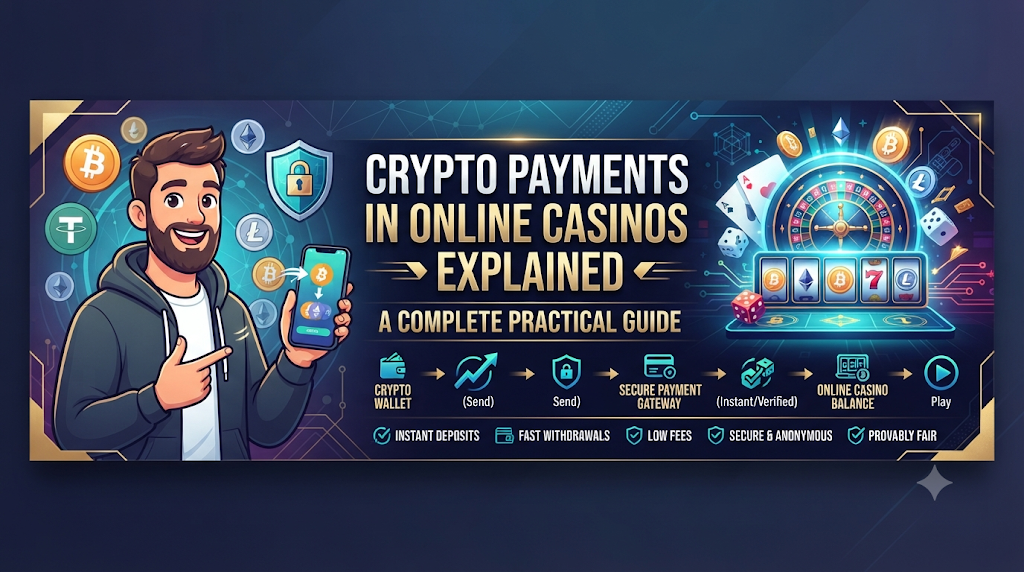
This guide breaks down crypto payments in online casinos step-by-step. You will learn the mechanics behind deposits and payouts, how to evaluate network fees, how to spot hidden volatility traps, and how to verify that transactions settle safely.
Core Concepts: The Building Blocks of a Crypto Payment
To understand how crypto works inside an online casino cashier, you only need to understand five core terms:
- Public Wallet Address: A string of numbers and letters that functions like an email address or an international bank account number (IBAN). You share this address to receive funds. An example looks like
0x71C...B29. - Private Key / Seed Phrase: The master digital password that controls your wallet. Anyone who knows your private key can steal your balance. You must never share this with a casino, an agent, or any website.
- Blockchain Network: The digital highway where transactions travel. Bitcoin (BTC), Ethereum (ERC-20), and Tron (TRC-20) are different networks. Sending funds across incompatible networks causes permanent loss.
- Network (Gas) Fee: The small fee paid to the computer operators (miners or validators) who process and secure your transfer. This fee goes to the network, not the casino.
- Block Confirmations: The number of new data blocks added to the chain after your payment is recorded. Casinos require between 1 and 6 confirmations before updating your playable balance to ensure the transaction cannot be rewritten.
How Casino Crypto Deposits and Withdrawals Work
A crypto transaction does not move physical coins. It updates a shared digital ledger showing that balance has shifted from one address to another.
The Step-by-Step Deposit Process
- Open the Cashier: Inside your casino account, select “Deposit” and choose your preferred cryptocurrency (for example, Bitcoin or USDT).
- Select the Exact Network: If you select a multi-chain token like USDT, the cashier will ask you to pick a network (such as Tron/TRC-20 or Ethereum/ERC-20). The sending wallet must match this selection.
- Copy the Unique Address or Scan the QR Code: The casino generates a temporary, unique receiving address tied directly to your player account.
- Send Funds from Your Wallet: Open your personal crypto wallet, paste the casino’s address, set the amount, review the network fee, and confirm the transfer.
- Wait for Confirmations: The blockchain groups your transaction into a block. Once the network confirms the block, the casino’s system automatically reflects the deposit in your account balance.
The Withdrawal Workflow
- Request Cashout: Navigate to the casino cashier, click “Withdraw,” and choose your coin.
- Paste Your Receiving Address: Open your personal wallet, copy your public receiving key, and paste it into the casino’s payout field.
- Operator Verification: Legitimate casinos run automated internal fraud checks and verify wagering requirements before signing the outbound transaction.
- Network Broadcast: The casino’s hot wallet broadcasts the payout to the blockchain.
- Receipt: As soon as the transaction is indexed on the blockchain, the crypto appears directly in your personal custody.
Evaluating Cryptocurrencies for Online Casino Use
Not all digital assets perform the same task. Using the wrong coin can result in paying more in transfer fees than the value of your intended wager, or watching your balance swing while waiting for a payout.
| Asset Type | Common Examples | Settlement Speed | Typical Network Fee | Best Use Case | Primary Limitation |
| Store of Value | Bitcoin (BTC) | 10 to 60 Minutes | Moderate to High ($1.00 – $15.00+) | Large balances, high-roller transfers | Slow confirmation times during high network traffic |
| Smart Contract Coins | Ethereum (ETH) | 1 to 5 Minutes | Highly Variable ($1.50 – $30.00+) | Broad acceptance across web3 gaming | Gas spikes make small deposits uneconomical |
| Low-Cost Altcoins | Litecoin (LTC), Ripple (XRP), Solana (SOL) | Under 3 Minutes | Very Low ($0.01 – $0.25) | Small, frequent deposits and withdrawals | Price moves against fiat currencies; lower cashier support |
| Stablecoins | USDT (Tether), USDC | 1 to 3 Minutes | Low on Tron/Polygon ($0.50 – $1.50) | Bankroll protection, avoiding price swings | Smart contract risk; network confusion traps |
Volatility vs. Price Stability: A Practical Decision
A frequent trap for beginners is ignoring currency volatility between the time a deposit is made and the time a withdrawal settles.
Consider a practical scenario:
Scenario A (Volatile Asset): You deposit $200 worth of Bitcoin. Over a weekend of play, your gameplay balance breaks even. However, during those two days, the global market price of Bitcoin drops by 8%. When you cash out, your Bitcoin buys fewer goods and services in the real world than it did on Friday.
Scenario B (Stablecoin Asset): You deposit 200 USDT using a low-cost network. USDT is pegged 1:1 to the US dollar. Your balance holds an exact fiat-equivalent value throughout your session, removing market timing risk completely.
If you treat crypto purely as a modern banking rail rather than an investment asset, stablecoins eliminate currency fluctuations while retaining the settlement speed of the blockchain.
Custodial Exchanges vs. Self-Custody Wallets
Where you store your funds matters as much as how you send them.
Why You Should Never Deposit Directly from a Centralized Exchange
Centralized exchanges (such as Coinbase, Kraken, or Binance) are regulated financial institutions. Their terms of service explicitly prohibit direct transfers to and from gambling portals.
If you send funds directly from an exchange account to an online casino cashier:
- The exchange compliance software will identify the casino’s destination wallet clustering patterns.
- Your exchange account may be frozen or permanently closed.
- Outbound exchange withdrawals batch transactions, which can delay casino deposits by hours.
The Correct Three-Step Custody Method
Always use an independent, non-custodial intermediary wallet (such as Exodus, Trust Wallet, or Phantom) to control your funds:
[ Centralized Exchange ]
          │
          ▼  (Buy crypto and withdraw to your own wallet)
[ Private Self-Custody Wallet ]
          │
          ▼  (Deposit directly to casino)
[ Online Casino Cashier ]
When cashing out, reverse the route: send from the casino to your self-custody wallet first, and only then route to your exchange account to sell for local currency.
Critical Risks and How to Mitigate Them
1. The Multi-Network Mismatch Trap
Certain tokens exist across multiple independent rails. For example, USD Tether (USDT) exists as an ERC-20 token on Ethereum, a TRC-20 token on Tron, and a BEP-20 token on BNB Chain.
- The Risk: Sending TRC-20 USDT to an ERC-20 casino address means the receiving smart contract cannot parse the input. The funds are permanently lost.
- The Solution: Always verify that the network selected in your wallet matches the destination network explicitly selected on the casino’s cashier screen.
2. Copy-Paste Malware (Clipper Trojans)
- The Risk: Malicious software running on a computer or mobile phone detects when a 40-character crypto address is copied to the clipboard. It instantly replaces that address with the attacker’s wallet address when you hit “Paste.”
- The Solution: Never assume a pasted address is correct. Always manually visually verify the first five and last five characters of the destination address before approving any broadcast.
3. Untracked Wagering Requirements on Pure Crypto Bonuses
- The Risk: Many crypto platforms advertise large deposit matches (e.g., “100% up to 1 BTC”). Because 1 BTC carries substantial purchasing power, clearing a 40x rollover requirement means you must wager massive sums before the software unlocks cashouts.
- The Solution: Calculate the exact monetary turnover required before opting into an automated promotion. If you deposit $100 and accept a bonus with a 40x rollover on deposit plus bonus, you must generate $8,000 in qualifying wagers before any withdrawal is approved.
Common Mistakes to Avoid
- Ignoring Network Congestion: Broadcasting transfers during major global market sell-offs causes transactions to wait in the “mempool” (transaction holding pen) for hours unless you pay inflated gas fees.
- Failing to Maintain Native Coins for Gas Fees: If you hold stablecoins (like USDT on the Ethereum network) in a private wallet, you cannot send them without owning a small balance of the base currency (ETH) to pay the validator fee. Keep a small reserve of the chain’s native token to avoid getting stuck.
- Overlooking Internal Casino Cashier Fees: While blockchain fees are standard, predatory casinos may tack on an extra 1.5% to 5% “processing fee” for crypto transactions. Always review the cashier’s terms of service before moving money.
- Discarding Transaction Hashes: Every crypto transfer produces an alphanumeric Transaction ID (TXID). If your deposit does not credit automatically within 30 minutes, casino support cannot help you without this public receipt.
Actionable Pre-Deposit Checklist
Run through this quick verification sequence before clicking “Send” on any casino transaction:
- I am sending funds from an independent, self-custody wallet (not directly from a centralized exchange).
- The asset chosen in my wallet matches the asset selected on the casino cashier screen.
- The transport network (e.g., BTC, TRC-20, ERC-20, Solana) is identical on both sides.
- I manually checked the first 5 and last 5 characters of the casino’s pasted address.
- My personal wallet holds enough native currency to pay the required network gas fee.
- I confirmed the casino’s minimum deposit limit (sending below the minimum threshold often results in voided deposits).
- I saved the Transaction Hash (TXID) after broadcasting the transfer.
Key Terms Explained
- TXID (Transaction Hash): A unique, public string of characters that proves an exact transfer took place on the blockchain. You can search this string on public ledger explorers like Etherscan or Blockchain.com to track transaction progress.
- Mempool: The waiting room of a blockchain where unconfirmed transactions wait for miners or validators to process them.
- Hot Wallet: A crypto wallet connected directly to the internet, used by casinos to process instant automated player withdrawals.
- Cold Storage: Offline hardware devices (like a Ledger or Trezor) used to store large balances away from internet vulnerabilities.
- KYC (Know Your Customer): Identity verification processes where casinos require passport, national ID, or utility bill scans. Many crypto casinos allow gameplay without upfront KYC, but invoke mandatory KYC checks during large payout reviews.
- Stablecoin: A cryptocurrency designed to hold a stable value by pegging its worth directly to an underlying fiat asset, most commonly the US dollar.
- Smart Contract: Self-executing digital code hosted on a blockchain that carries out actions automatically once predefined terms are met.
Frequently Asked Questions
Are crypto transactions in online casinos completely anonymous?
No. Cryptocurrencies like Bitcoin, Ethereum, and Tether are pseudonymous, not anonymous. Every transaction is recorded forever on a transparent, public ledger. If you ever link your personal identity to a wallet through an exchange, forensic tools can tie your wallet activity and casino deposits straight back to your identity.
Can a casino reverse a crypto transaction if I make an error?
No. Blockchain architecture does not feature an administrator, customer support desk, or chargeback mechanism. Once a transaction gets written into a confirmed block, it is permanent. If you send funds to an incorrect address or pick the wrong network, neither the casino nor your wallet provider can recover the funds.
Why do some crypto deposits show up instantly while others take an hour?
Speed depends on the underlying blockchain architecture and the number of confirmations the casino requires. Networks like Solana or Tron finalize blocks in seconds. Bitcoin generates a new block roughly once every 10 minutes; if a casino requires three block confirmations, your balance takes at least 30 minutes to appear.
Do I have to pay taxes on crypto casino winnings?
In most jurisdictions, tax authorities treat cryptocurrency as capital property or income. Winning cryptocurrency at an online casino, or realizing capital gains when selling those winnings for local fiat currency, typically triggers reporting requirements. Consult a tax professional familiar with local laws in your home country.
What happens if I deposit less than the casino’s stated minimum crypto amount?
Most crypto casino cashiers maintain strict minimum deposit thresholds to prevent their accounting systems from getting flooded with tiny balances. If you deposit an amount below this line, the system will not credit your balance, and the software is often incapable of refunding amounts that do not meet the minimum gas fee.
Why does my casino balance display in USD or EUR if I deposited Bitcoin?
Many traditional casinos run their internal gaming engines on traditional fiat currencies. When your Bitcoin hits their address, their backend system locks the deposit value to the prevailing spot price and shows a standard currency balance. When you withdraw, the system converts that balance back into an equivalent amount of Bitcoin. Always verify whether the casino maintains your native coin balance or runs an internal currency conversion.
Are crypto casinos legal to play at?
Legality depends entirely on your regional gambling laws and financial regulations. Using cryptocurrency does not bypass local online gambling prohibitions. If online gambling is restricted in your jurisdiction, accessing an offshore crypto casino carries regulatory and legal risks regardless of the payment method used.
Is it safe to leave my balance inside the casino account after playing?
No. A casino account is not a personal savings bank. Casino balances remain under the complete control of the operator. Once you finish a gaming session, withdraw your remaining balance back to your private, self-custody wallet where you hold your own private keys.
Conclusion
Crypto payments eliminate the middleman in online gaming, offering faster payouts, lower transaction barriers, and direct custody control over your bankroll. However, this freedom shifts complete responsibility to you. By routing transfers through a private wallet, selecting stable currencies to avoid sudden market drops, and double-checking addresses and networks before every transfer, you can move funds safely, predictably, and without unexpected losses.
