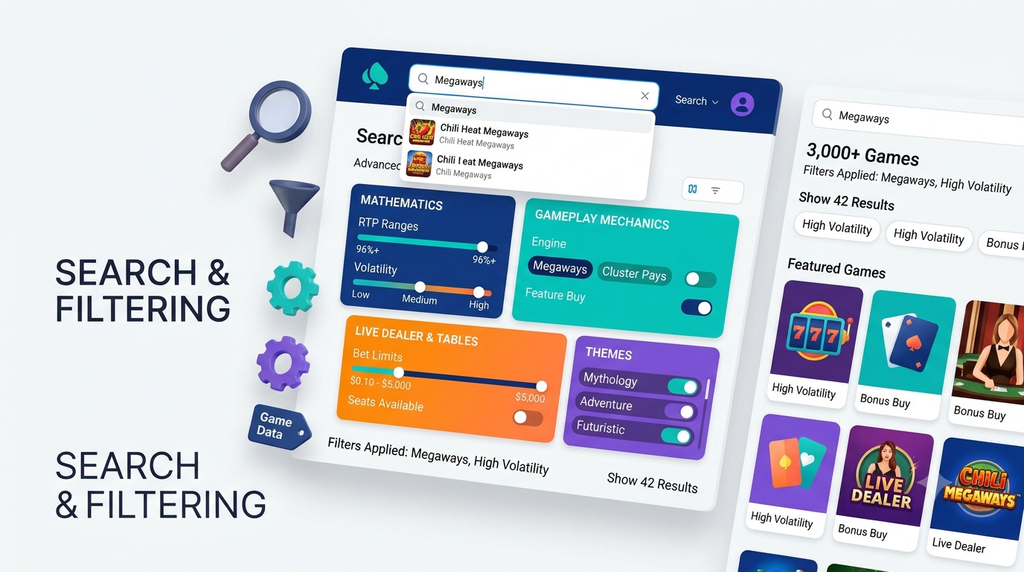
Modern online casino lobbies routinely hold between 3,000 and 8,000 individual titles. Without structured search and granular filtering, a library of that size creates choice overload, forcing players to scroll through endless thumbnail grids before abandoning the lobby altogether.
Effective game discovery depends on the underlying game metadata? feeding the front-end search bar and filter menus. When operators tag titles accurately across mechanics, math profiles, and table parameters, players can narrow thousands of options down to a handful of relevant matches in seconds.
Why Generic Category Tabs Fall Short
Early online casinos relied on broad top-level tabs such as “New,” “Popular,” “Slots,” and “Table Games.” While those buckets still exist for casual browsing, they fail when a player has a specific style of play in mind.
A player looking for a low-volatility cluster-pays slot with a bonus buy option cannot find it through a “Popular” tab. Similarly, a blackjack player seeking a low-stakes table with specific side bets wastes time opening and closing lobbies just to check minimum wagers. Granular data fields solve this friction by turning static game thumbnails into searchable, queryable records.
Core Mathematical and Payout Data Fields
Experienced players frequently choose games based on how a title behaves financially over time rather than its visual theme. Exposing mathematical attributes directly in the filter panel builds trust and speeds up decision-making.
- Return to Player (RTP) Ranges: Allowing users to filter by theoretical payout percentages—such as 96% and above—helps value-focused players locate favorable titles. Because many modern studios release games with variable RTP configurations, platforms must sync the filter tag with the actual active configuration rather than a generic studio default.
- Volatility / Variance Tiers: Categorizing games into Low, Medium, High, and Extreme volatility lets players match a game’s risk profile to their bankroll. Low-volatility tags appeal to users seeking longer sessions with frequent smaller payouts, while high-volatility filters serve players chasing larger, less frequent multipliers.
- Hit Frequency: Often paired with volatility, hit rate indicates how often a spin produces any winning combination. Including hit frequency bands helps clarify the difference between two games that share the same volatility rating.
- Maximum Win Potential: Expressed as a multiplier of the base stake (for example, 5,000x or 20,000x), max exposure tags help players quickly identify high-ceiling titles without opening individual paytables.
Gameplay Mechanics and Feature Attributes
Visual themes change constantly, but underlying game engines follow recognizable patterns. Tagging functional mechanics allows players who enjoy a specific rule set to discover similar releases across different studios.
| Data Field | Common Filter Values | Discovery Value for Players |
|---|---|---|
| Reel & Grid Engine | 5×3 Classic, Megaways, Cluster Pays, Infinity Reels, Pay Anywhere | Separates traditional payline slots from dynamic or grid-based systems. |
| Bonus Mechanics | Free Spins, Hold & Win, Cascading Reels, Expanding Wilds, Sticky Wilds | Lets players isolate the exact bonus round style they prefer. |
| Feature Buy / Bonus Buy | Available, Unavailable, Multi-Tier Buy | Filters out restricted or standard-only games for players who want direct bonus access (where permitted by local regulations). |
| Jackpot Type | Fixed, Local Progressive, Network Progressive, Must-Drop / Hourly | Distinguishes standard payout games from pooled prize systems. |
| Payline / Ways Count | 1–10 Lines, 20–50 Lines, 243 Ways, 1,024+ Ways, Up to 117,649 Ways | Clarifies bet structure and win evaluation complexity at a glance. |
Live Dealer and Table Game Parameters
Table games and live casino lobbies require an entirely different taxonomy than slots. Players browsing live dealer streams evaluate real-time availability, table rules, and betting thresholds before joining a stream.
- Minimum and Maximum Bet Limits: Displaying live stake ranges directly in the lobby filter prevents players from loading streams outside their budget. Dynamic data feeds should update these limits automatically if a table shifts tiers during peak hours.
- Seat Availability: For seven-seat blackjack tables, a “Seats Available” toggle saves players from entering full rooms where they can only place Bet Behind wagers.
- Rule Variations and Side Bets: Tagging specific rule sets—such as European vs. American Roulette, Single-Deck Blackjack, Speed Baccarat, or side bets like Perfect Pairs and Lightning multipliers—eliminates guesswork.
- Dealer Language and Studio Location: International platforms serve multilingual audiences. Filtering live tables by native dealer language (such as English, Spanish, German, or Hindi) and dedicated studio branding makes localization practical.
Predictive Search and Autocomplete Data Signals
Filter sidebars work best for browsing, while the search bar handles direct intent. A capable casino search engine processes more than exact game titles.
- Software Provider and Studio Aliases: Players often search for parent companies or subsidiary studios (for instance, searching either a major aggregator name or the independent boutique studio behind a release). Mapping studio aliases prevents zero-result searches.
- Franchise and Series Grouping: Popular slot families often span dozens of sequels and seasonal editions. Tagging titles under unified franchise IDs ensures a search for a flagship title surfaces its spin-offs in a logical order.
- Typo Tolerance and Phonetic Matching: Game titles frequently use stylized spellings, numerals, or mythological names. Implementing fuzzy matching? ensures minor spelling errors still return the intended game.
- Theme and Aesthetic Tags: Secondary descriptive tags—such as Ancient Egypt, Mythology, Fishing, Retro Fruit, or Crime—bridge the gap when a player remembers a game’s visual setting but forgets its exact name.
Regulatory and Jurisdiction Filtering Rules
Search and discovery systems in regulated iGaming markets must also enforce compliance boundaries invisibly in the background. Not every game or feature is legal across every licensing jurisdiction.
- Geo-Restricted Catalog Filtering: Game aggregation platforms use player IP and account jurisdiction data to hide uncertified titles before search results render, preventing players from clicking into blocked games.
- Feature-Level Compliance Flags: Regulators in jurisdictions such as the UK Gambling Commission (UKGC) prohibit autoplay and bonus buy features, and enforce minimum spin speeds. Metadata flags allow platforms to suppress “Bonus Buy” filter tags automatically for users logged in from restricted regions.
- Demo Mode Availability: Certain regions require age and identity verification before allowing free-play access. Filtering by “Demo Available” helps verified users test mechanics responsibly without risking real funds.
Frequently Asked Questions
How many filters should an online casino lobby display at once?
Most high-performing lobbies display five to seven primary filter categories on the surface—such as Provider, Volatility, Mechanics, Theme, and Features—while tucking deeper parameters like RTP ranges or payline counts inside an expandable “Advanced Filters” drawer to keep the interface clean on mobile screens.
Why do some casino search bars fail to find games when players type a provider name?
This usually happens when the search index only queries the game_title database column. Indexing both provider_name and sub_studio_name alongside game titles allows users to type a studio name directly into the search bar and view its full catalog immediately.
How does game metadata affect mobile casino discovery?
On smaller screens, typing long queries is inconvenient. Well-structured metadata powers tap-friendly horizontal filter chips (such as “Megaways,” “High Volatility,” or “Live Blackjack”), allowing mobile users to refine results with one thumb rather than typing.
Should RTP always be included as a public search filter?
While transparency builds user trust, platforms must ensure the displayed RTP filter matches the exact version hosted on their server. Because game providers offer multiple RTP profiles for the same title, displaying inaccurate filter data can create regulatory compliance issues and player disputes.
Bringing Structure to Large Game Libraries
As online casino catalogs continue to expand, raw game volume is no longer a competitive advantage on its own. Discovery tools determine whether players actually reach the titles suited to their preferences. By standardizing mathematical tags, mechanical attributes, live table limits, and jurisdiction-aware filters, platforms transform massive content libraries into intuitive, fast-navigating lobbies.
