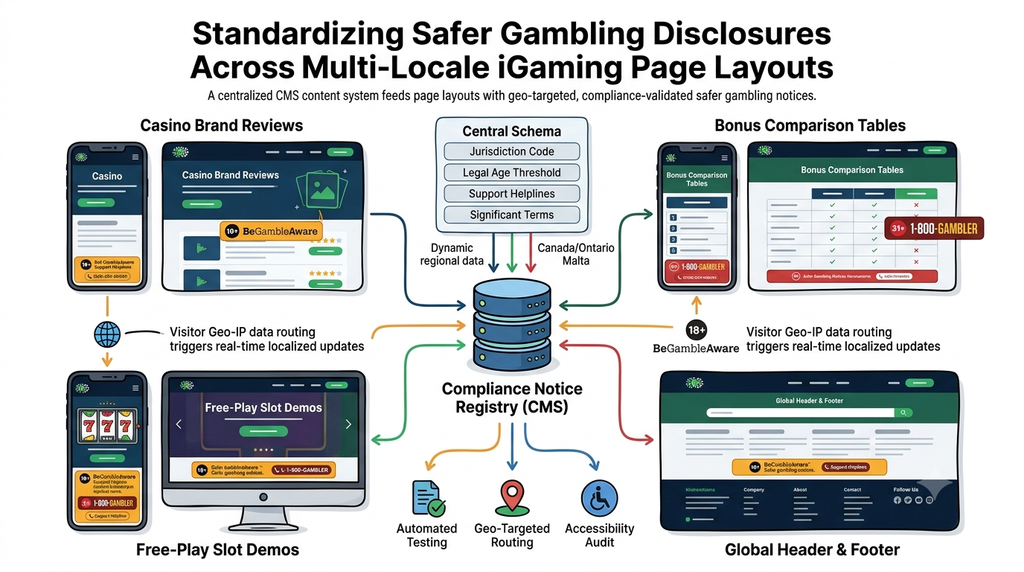
When an iGaming publisher scales beyond a single country or launches new content verticals—such as live dealer lobbies, crash game calculators, or odds comparison widgets—static text disclaimers break down fast. What begins as a single warning line in a site footer quickly fractures into dozens of inconsistent snippets across legacy blog posts, landing pages, and dynamic affiliate comparison cards.
For product managers, compliance leads, and CMS engineers building on platforms like CasinoBullseye, keeping safer gambling disclosures accurate is fundamentally a data-modeling and rendering problem. Regulatory frameworks require that gambling advertising and informational content accurately reflect rules without misleading readers, while displaying jurisdiction-accurate problem-gambling resources. Treating these notices as reusable, schema-enforced layout primitives ensures every page stays compliant without slowing down editorial publishing.
Where Static Disclaimers Fail in Modern iGaming Platforms
Hardcoding legal text into individual page builders or rich-text editors creates blind spots that manual reviews rarely catch in time:
- Orphaned Legacy Content: High-traffic evergreen guides published two or three years ago often retain retired helpline phone numbers, defunct self-exclusion branding, or outdated minimum age thresholds.
- Component Collisions on Mobile Viewports: Sticky bonus bars, cookie consent modals, and floating safer gambling badges frequently overlap on smaller screens, obscuring required regulatory text and failing visual contrast or legibility standards.
- Single-Page Application (SPA) Route Transitions: In React, Vue, or Next.js frontends, navigating from an informational strategy guide to a commercial operator review can leave stale, non-commercial notice states mounted in the DOM if compliance state is not tied directly to route metadata.
- Uncoupled Bonus Feeds: When third-party APIs update promotional offers overnight—changing a free spins package into a deposit match—static disclaimer text written by an editor no longer matches the active wagering terms rendered on screen.
Architecting a Schema-Driven Disclosure Engine
Rather than asking writers to remember which disclaimer belongs on which page, define a strict Disclosure Schema in your headless CMS or database layer. Every page template queries this schema at build time or edge runtime to assemble the exact compliance elements required for that route.
Core Data Fields for a Compliance Snippet
Each regional or product-specific notice object should be stored as structured JSON rather than raw HTML blobs:
jurisdiction_code: ISO country or state/province identifier (e.g.,GB,CA-ON,US-NJ,DE,MT).legal_age_threshold: Integer value (18,19, or21) rendered inside standardized visual badges.commercial_intent_tier: Enum (informational,review,promotional_table,demo_play,support_hub) that dictates how prominently terms must appear.helpline_entities: Array of verified support organizations, phone numbers, SMS shortcodes, and direct URLs mapped strictly to the visitor’s region.mandatory_terms_flags: Boolean triggers enforcing whether significant bonus terms (wagering multiplier, minimum deposit, max cashout, expiry window) must render inline alongside a CTA.
Tailoring Disclosure Placement by Page Layout
Different user journeys carry distinct regulatory obligations. A player reading a mathematical breakdown of blackjack house edge interacts with the page differently than a visitor clicking a “Claim Offer” button or launching a browser-based slot demo.
| Page Layout Archetype | Primary User Action | Required Visual & Structural Treatment | Engineering Safeguard |
| Editorial Strategy & Math Guides | Reading educational probabilities, game rules, or industry analysis | Persistent header age badge plus a clean, high-contrast footer block linking to regional support directories | Suppress aggressive promotional pop-ups so educational content remains distinct from direct inducement |
| Operator Comparison & Rankings | Filtering licensed platforms and comparing welcome packages | Inline micro-disclosure directly beneath every operator card CTA, paired with an expandable significant-terms drawer | Block card rendering at the API level if license_number or significant_terms fields return null |
| Interactive Slot & Crash Game Lobbies | Launching free-play HTML5 demos or checking RTP/volatility metrics | Pre-game age confirmation gate and a persistent frame header reminding players that demo outcomes do not guarantee real-money results | Prevent the game iframe from initializing until the user confirms legal gambling age for their detected locale |
| Software & CMS Architecture Reviews | Evaluating B2B platform tools, payment gateways, or compliance modules | Standard site-wide age notice and commercial/editorial independence disclosure | Separate B2B technical documentation templates from B2C player-facing bonus modules |
| Safer Gambling & Self-Exclusion Hub | Seeking budgeting tools, cooling-off periods, or addiction counseling | Zero commercial operator links, zero bonus banners, and prominent click-to-call / live-chat helpline buttons | Enforce a template-level allowlist that strips all affiliate tracking scripts and commercial widgets from this route |
Handling Multi-Locale Routing Without Hurting Search Visibility
Serving localized safer gambling notices across international traffic requires careful coordination between edge geo-routing and search engine crawling. If your server aggressively redirects or blocks search engine bots based on IP location, crawlers may fail to index your primary content or misinterpret regional variants.
To keep international SEO clean while serving accurate regional disclosures:
- Decouple Main Editorial Copy from Edge-Injected Notices: Keep your primary article body static and cacheable on your CDN so Googlebot and other crawlers read fast, consistent HTML. Inject or hydrate the localized safer gambling banner via edge workers or non-blocking client islands tied to the user’s
Accept-Languageand Geo-IP headers. - Use Dedicated Subfolders for Regulated Markets: For major regulated territories (such as
/uk/,/ca-on/, or/de/), maintain dedicated URL structures with validhreflangannotations. Bake that market’s exact regulatory copy, currency symbols, and local helpline details directly into the server-rendered HTML for that subfolder. - Preserve Accessibility and Semantic Structure: Output all notices using standard semantic tags (
<section aria-label="Responsible Gambling Notice">) with sufficient color contrast (minimum WCAG AA 4.5:1 ratio) rather than embedding legal text inside decorative images that screen readers cannot parse.
Automated Regression Testing for Compliance Templates
Deploying clean templates is only half the workflow; layout updates, CSS refactors, and third-party ad script changes can accidentally hide or break safer gambling notices in production. Integrate automated compliance checks directly into your Continuous Integration / Continuous Deployment (CI/CD) pipeline.
Practical Checks to Automate Before Every Release
- End-to-End Viewport Assertions (Playwright / Cypress): Run headless browser tests across desktop (
1440x900) and mobile (390x844) viewports using simulated proxy headers for each target jurisdiction. Assert that the age badge, primary helpline link, and CTA micro-terms are visible in the DOM and not covered by overlapping modals (elementFromPointcheck). - Broken Helpline Link Monitoring: Schedule weekly HTTP status checks on every external support URL stored in your Compliance Notice Registry so renamed government portals or updated NGO domains never result in a
404error. - DOM Snapshot Diffing: Capture baseline HTML snapshots of your commercial templates whenever compliance copy is updated. If a frontend pull request alters or removes mandatory disclosure nodes without an authorized compliance approval tag, fail the build automatically.
Frequently Asked Questions
How can multi-brand casino portals share compliance notices without duplicating work?
Store all safer gambling notices inside a central microservice or shared headless CMS collection, then expose them via a versioned REST or GraphQL endpoint. Each frontend brand consumes the same verified regulatory payloads while styling the wrapper component to match its own design system.
What should happen if a user accesses a site using a VPN or masked IP address?
When geo-detection returns an ambiguous or unrecognized region, fall back to a strict default notice displaying the highest applicable age threshold (21+ or local legal minimum), clear risk warnings, and links to international support networks such as Gambling Therapy alongside a manual region selector.
Why must free-to-play slot demo templates carry safer gambling notices?
Many gambling regulators classify free-to-play casino demos as promotional tools that simulate real wagering mechanics. Displaying a clear age gate and an “entertainment only—no real-money payouts” disclosure prevents underage access and avoids misleading players about win frequencies.
Can expandable accordions be used for bonus terms inside compact mobile tables?
Yes, provided the core age restriction, primary risk warning, and main qualifying conditions (such as minimum deposit and wagering requirement) remain immediately visible without requiring a tap. Secondary legal clauses can sit inside an accessible accordion directly beneath the CTA.
How do compliance teams verify when a specific disclaimer went live on a page?
Maintain an immutable audit log inside your CMS database that records every modification to disclosure templates, including user ID, timestamp, previous string, and new string, paired with periodic automated screenshot archives of key commercial URLs.
Making Safer Gambling Part of Your Design System
When safer gambling disclosures live inside your core component library—governed by strict database schemas, edge-aware localization, and automated viewport tests—compliance stops being a last-minute editorial checklist. Your engineering team gains predictable layouts, your writers stay focused on accurate analysis, and readers receive clear, reliable consumer protection regardless of which device or jurisdiction they browse from.
