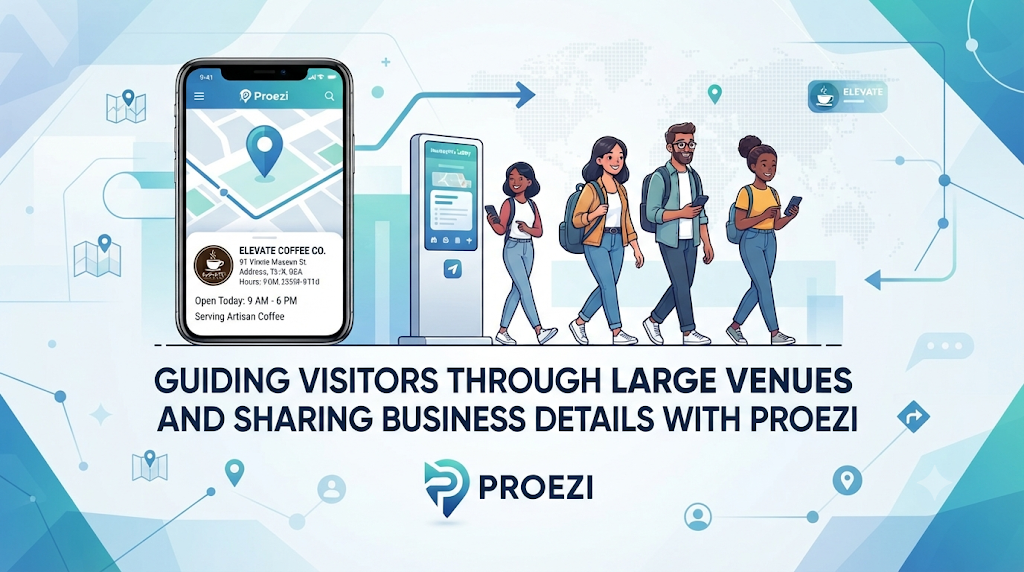
The bigger a venue gets, the harder it becomes to explain. A small shop needs one sentence of directions. A site with several halls, a multi-level car park, a staff gate and a delivery bay needs a different answer for almost every person who arrives. Behind the scenes, the same site deals with many suppliers who each need payment and company details.
Proezi is a web-based platform that helps organizations handle both sides of this problem. It lets them publish visitor directions, payment details and business identity information on separate pages, then share each page through a reusable link or a QR code. This article looks at how large and busy venues can use it, and where the limits are.
Why Large Venues Struggle with Arrival
A map pin can bring someone to a large complex, but a pin cannot say which gate is open, which car park level is closest or where the registration desk sits. People often reach the right address and still feel lost. That final stretch is what many call last mile navigation for businesses, and it is where delays, phone calls and frustration tend to begin.
Venue teams often respond with long messages or a printed map. These work until something changes. Once a route is altered, every earlier message is out of date and no one can fix it.
Following the Visitor from Road to Room
A useful way to plan any arrival page is to follow one visitor through the whole trip and write down each decision point.
- On the road: which approach to take and where the turn is.
- At the car park: which entrance to use and where to leave the vehicle.
- At the outer gate: whether there is a security check and what is needed.
- At the building: which door leads to the right wing.
- Inside: where reception is, which lift or stairs to use, and how to find the room or hall.
Proezi supports this kind of step-by-step approach. Instructions can cover parking areas, entrances, gates, reception desks, lifts, floors and specific rooms. Annotated photographs, map coordinates and entrance landmarks make each step easier to recognize, and an emergency contact button gives lost visitors a way to reach the team. For the outdoor part of the journey, visitors can open Google Maps, Apple Maps or Waze, then follow the published steps for the rest.
Different Groups Need Different Arrival Instructions
One route rarely suits everyone. A large venue usually receives several kinds of arrivals on the same day:
- Guests and attendees, who want the main entrance and the closest parking.
- People on foot or by taxi, who need a drop-off point and a pedestrian path.
- Visitors who need step-free access, who need to know where ramps and accessible doors are.
- Delivery drivers and vendors, who must use a service gate and a loading area, not the front door.
Proezi allows separate arrival routes for drivers, pedestrians, taxis, deliveries and step-free visitors. This means a single set of digital visitor arrival instructions can speak to each group directly, without sending everyone down the same path.
Placing QR Codes Across a Big Site
A code is only as useful as its location. For parking and entrance directions for visitors, the best spots are places where a person has to make a choice or may feel unsure.
- The entrance to the car park, so drivers scan before they park.
- Each car park level, in case a visitor needs to find the lift.
- The main doors and any side doors that are often confused.
- Booking confirmations, tickets and reminder emails.
- The venue’s own website, using an embedded arrival card.
An event venue directions QR code works best when it is large enough to scan from a short distance, placed at a comfortable height and lit properly. Always scan every code yourself before printing. A QR code does not provide live indoor positioning. It opens the published instructions, and the visitor does the rest.
Handling Changes During Busy Periods
Busy periods are when access conditions change the fastest. A gate may close for a delivery, a hall may open early, or a car park level may fill up. Proezi lets a business add temporary notices to an arrival page, so people see the change when they open it. The link and the printed codes stay exactly the same.
Directions can also be offered in more than one language, which helps when visitors come from different places. Directions that a visitor has opened earlier may still be available if their connection becomes weak, though a fresh connection is the safest way to see recent notices.
Back-Office Pages for Suppliers and Partners
Visitors are only half the story. Behind the scenes, venues and hospitality businesses work with caterers, contractors, maintenance teams and equipment hirers. These partners ask for the same details again and again.
Payment Instructions for Regular Suppliers
A business that needs to share bank details with customers or partners can place them on a payment page instead of repeating them in messages. The page can hold bank transfer instructions, account details, UPI information, PayPal details and supported international identifiers. It can also show a payment-purpose reference and offer details that are easy to copy. A UPI QR code payment page can be printed for a front counter or added to an invoice.
Proezi only displays this information. It does not process, collect or transfer payments, and it is not a bank or wallet. Customers and partners complete the payment in their own banking or payment app.
Company Details Without Repeated Requests
Partners also ask for a registered business name, a registration identifier or a tax number. A separate identity page makes it easier to share business registration details online when someone asks for them. Supported identifiers pass through format and checksum checks. The platform does not confirm ownership or registration status with a government authority, so a published number is not proof that a company is genuine. Partners should still verify through official channels.
Boundaries and Responsibilities to Keep in Mind
Every tool has edges, and good planning starts by knowing them.
- Pages are only as accurate as the people who maintain them.
- A QR code opens a page and does not guarantee anyone’s safety or access.
- Payment pages show details and do not confirm that a payment arrived.
- Identity pages do not replace official registration checks.
- Customer-created pages are kept out of search indexing, so they are for direct sharing rather than for gaining new customers through search.
- Sensitive pages should go only to the people who need them.
A Hypothetical Walk Through a Multi-Hall Venue
Imagine an entertainment complex with three halls, a car park spread over several levels and a separate gate for deliveries. The operations team creates one arrival page for guests, one for taxi and walking arrivals, and one for deliveries. Each includes photographs of the correct door and a contact button. QR codes go on the car park boards and on the doors, and the booking emails carry the link. When a hall is moved for a day, the team adds a notice. Separately, the finance office publishes a payment page and an identity page for its regular suppliers, so questions about account details and registration numbers drop.
Rolling Out in Three Gentle Phases
Phase one. Pick the entrance or route that causes the most confusion. Build a single page for it, test the QR code and place it.
Phase two. Add the other arrival groups, such as taxis, deliveries and step-free routes, then include notices for known changes.
Phase three. Add the payment and identity pages for suppliers, and set a regular review date for everything.
Proezi launched in September 2026 and is currently free during early access, so a small trial carries low cost.
Everyday Questions From Venue Managers
Can taxis and deliveries get separate routes?
Yes. Separate routes can be published for drivers, pedestrians, taxis, deliveries and step-free visitors.
Is an internet connection always required?
Not always. Directions opened earlier may be available from the device, but a live connection is best for current notices.
Where do the map apps fit in?
Visitors can use Google Maps, Apple Maps or Waze for the journey to the site, then follow the written steps to the exact door.
Can the same link be reused later?
Yes. The link and QR code stay the same, and the content behind them can be updated.
Do pages replace staff at the entrance?
No. They reduce repeated questions, but people at the entrance remain important for security, welcome and special cases.
Which Proezi function suits suppliers best?
Payment pages and identity pages are the most relevant, because suppliers usually need account details and company information.
Final Reflection on Clear Communication
Large venues succeed when people feel looked after from the moment they leave home, and much of that feeling comes from small, clear pieces of information. Where to park, which door to use and who to call matter just as much as anything inside the building. The same is true behind the scenes, where suppliers want accurate details without chasing for them. Proezi offers a straightforward way to keep these answers in one place and update them when things change, while being open about what it does not do. Teams that keep their pages current, test their signs and treat sensitive details with care will find that most arrivals become smoother and most repeated questions fade away.
