Introduction
Running an online gaming platform is very different from managing a standard e-commerce store or content blog. While a normal website might focus purely on writing articles or selling physical goods, an online casino operates in a heavily regulated, legally complex, and fiercely competitive market.
Many new operators make the mistake of assuming that simply launching a platform and running basic banner ads will automatically fill their digital lobby with active players. In reality, modern casino traffic generation requires a careful balance of legal compliance, technical SEO, high-value player incentives, and rigorous trust signals. If your site lacks security certificates, payment reliability, or search visibility, visitors will leave within seconds.
This guide explains how professional gaming platforms attract visitors, which strategies actually work, what legal risks to avoid, and how to turn casual visitors into loyal, long-term players.
What Is Casino Traffic Generation?
Casino traffic generation is the process of attracting potential players to a digital gaming platform through organic search results, paid digital campaigns, social media, and third-party referral networks.
Why It Matters
Without a steady flow of targeted visitors, even the most advanced gaming platform with the best slot providers and live dealer tables will fail. However, raw visitor volume means very little if those visitors are not interested in online gaming or live in regions where the platform cannot legally operate.
The Core Difference: Quality vs. Quantity
In standard retail marketing, a click is a click. In the gaming industry, traffic quality is everything:
- Low-Quality Traffic: Visitors who click by accident, cannot legally gamble in their region, or deposit very little and never return. This wastes advertising budget.
- High-Quality Traffic: Users who understand online gaming, reside in legal jurisdictions, trust your platform, and have a higher lifetime value (LTV).
How Casino Traffic Generation Works
Attracting players follows a structured pipeline that moves a curious web user from an initial search query to an active, verified account holder.
[Search Engine / Ad] ➔ [Landing Page / Bonus Offer] ➔ [Trust & Compliance Check] ➔ [Account Registration] ➔ [First Deposit & Retention]
- Discovery: The user searches for a specific game, bonus type, or review on Google, or clicks an ad on a partner site.
- Landing: The user arrives at a targeted landing page optimized for fast loading and clear legal disclaimers.
- Conversion: The user sees a compelling welcome offer, verifies their identity, and creates an account.
- Retention: The platform uses ongoing promotions, personalized emails, and loyalty rewards to keep the player engaged.
Primary Traffic Channels Used by Online Gaming Sites
Different marketing channels serve different purposes. Successful platforms diversify their acquisition efforts across several key pillars.
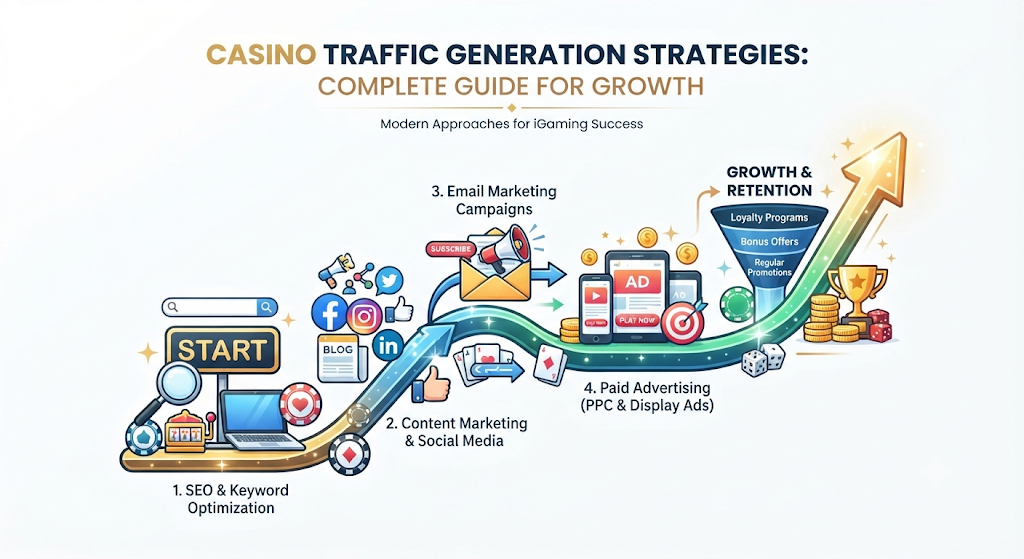
1. Search Engine Optimization (SEO)
SEO focuses on ranking your website organically in search engine result pages for terms related to online slots, poker, sports betting, and casino reviews. Because paid advertising is restricted on major search engines in many countries, SEO is often the most cost-effective long-term traffic source.
2. Affiliate Marketing
Affiliate marketing involves partnering with third-party review sites, streamers, and comparison portals that send depositing players to your platform in exchange for a revenue share or cost-per-acquisition (CPA) fee. This is one of the largest traffic drivers in the global gaming industry.
3. Paid Search and Display Advertising (PPC)
Pay-per-click advertising on Google, Bing, and social media platforms allows operators to target high-intent search terms. However, running PPC ads requires strict adherence to platform policies, age-verification filters, and regional licensing documentation.
4. Social Media and Community Engagement
Platforms build communities on channels like Telegram, Discord, and X (formerly Twitter) to share updates, host tournaments, and communicate directly with active players.
Important Factors to Understand
Before investing time or money into any traffic campaign, you must understand the underlying constraints that govern the online gaming sector.
- Licensing and Jurisdiction: You cannot market a casino globally without restrictions. Your traffic campaigns must target users located in regions where your specific operating license is valid.
- Responsible Gambling Mandates: Modern traffic strategies must incorporate responsible gaming messages, self-exclusion links, and age-verification warnings to comply with regulatory bodies like the UK Gambling Commission or Malta Gaming Authority.
- Payment Gateway Restrictions: Many credit card companies and digital wallets block transactions linked to unverified or offshore gaming sites. Your traffic must flow to a site that offers smooth, localized deposit methods.
Common Mistakes in Casino Traffic Generation
Many operators and marketers burn through large budgets because they fall into predictable traps.
| Common Mistake | Why It Happens | Why It Fails | What to Do Instead |
|---|---|---|---|
| Buying Bulk Traffic | Wanting quick numbers and instant sign-ups. | Results in bot traffic, zero deposits, and potential penalties from ad networks. | Focus on organic search and verified affiliate networks. |
| Ignoring Local Regulations | Believing the internet is borderless. | Leads to heavy fines, blocked domains, and frozen merchant accounts. | Implement strict geo-targeting and verify user locations. |
| Misleading Bonus Claims | Trying to trick users into clicking with fake promises. | High bounce rates, immediate chargebacks, and destroyed brand trust. | Clearly state wagering requirements and bonus terms upfront. |
| Slow Mobile Performance | Assuming players only use desktop computers. | Over 70% of casino traffic comes from mobile phones; slow pages kill conversion. | Optimize site speed and mobile touch navigation. |
Risks and Limitations
Every traffic strategy carries inherent operational and financial risks that require active management.
Regulatory and Legal Risk
Risk: Running ads in unauthorized regions can result in legal action or domain seizure.
Reduction Method: Use advanced geolocation software and verify local licensing requirements before launching any campaign.
Click Fraud and Bot Traffic
Risk: Paying affiliates or ad networks for fake clicks generated by automated software scripts.
Reduction Method: Monitor user behavior analytics, track conversion rates per traffic source, and work only with trusted, reputable affiliate networks.
High Customer Acquisition Cost (CAC)
Risk: Spending more money to acquire a player than that player will ever deposit.
Reduction Method: Calculate customer lifetime value (LTV) carefully and optimize your retention funnels to keep players active longer.
Decision-Making Framework for Operators
When deciding where to allocate your traffic generation budget, use this simple step-by-step framework:
- Check Your License: Confirm exactly which countries and states your gaming license allows you to target.
- Audit Your Technical Setup: Ensure your website loads in under three seconds on mobile devices and has secure SSL encryption.
- Analyze Competitor Traffic: Review where your top competitors are getting their organic backlinks and referral traffic.
- Choose Your Primary Channel: If budgets are tight, invest in long-term SEO and content marketing. If you have immediate capital, combine targeted PPC with trusted affiliate partnerships.
- Monitor Compliance: Regularly audit your landing pages, promotional banners, and ad copy to ensure they meet local advertising standards.
Key Terms
- CPA (Cost Per Acquisition): A pricing model where an operator pays an affiliate or marketer a fixed fee only when a referred user registers and makes a real-money deposit.
- RevShare (Revenue Share): An ongoing commission structure where the affiliate receives a percentage of the net gaming revenue generated by the players they refer.
- Wagering Requirement: A multiplier condition that tells a player how many times they must play through a bonus amount before they can withdraw any winnings derived from it.
- LTV (Lifetime Value): The total estimated net revenue a gaming platform can expect from a single player throughout their entire time using the site.
- Conversion Rate: The percentage of website visitors who complete a desired action, such as creating an account or making a first deposit.
- Geo-Targeting: The practice of delivering different website content or ads to users based on their specific geographic location.
- Organic Traffic: Visitors who arrive at your website naturally through search engine results pages rather than via paid advertisements.
- Bounce Rate: The percentage of visitors who navigate away from your website after viewing only a single page.
FAQs
What is the most effective traffic source for a new online casino?
For long-term stability, search engine optimization combined with trusted affiliate partnerships is generally the most effective approach. Paid advertising can provide immediate volume, but it comes with strict platform restrictions and high costs.
Why do casino ads get blocked on Google and Facebook?
Major advertising networks enforce strict policies regarding online gambling due to age restrictions, legal variations across different countries, and consumer protection laws. Advertisers must hold official local licenses and pass rigorous account verification processes.
How do I stop bot traffic from wasting my advertising budget?
You can protect your platform by using click-fraud detection software, monitoring traffic anomalies in your analytics dashboard, and partnering exclusively with verified, reputable affiliate networks that track real player deposits.
What is a good conversion rate for an online gaming site?
Conversion rates vary widely depending on the traffic source and bonus offers, but a healthy sign-up-to-deposit conversion rate typically ranges between 5% and 15% for targeted, high-intent traffic.
How do wagering requirements affect player retention?
High or confusing wagering requirements can frustrate players and cause them to leave permanently. Transparent, fair bonus terms build long-term trust and encourage repeat visits.
Conclusion
Generating traffic for an online gaming platform is not about shouting the loudest or buying the most banner ads. It is a precise discipline combining technical search optimization, legal compliance, transparent player incentives, and rigorous data analysis. By focusing on high-quality, targeted visitors who reside in legal jurisdictions and trust your platform, you build a sustainable foundation for long-term growth.
