Introduction
The online gambling industry is crowded, fast-moving, and often confusing for everyday users. With hundreds of platforms vying for attention—each promising massive welcome bonuses, instant payouts, and thousands of games—players face a major challenge: How do you separate trustworthy operators from risky ones?
This is where comparison platforms come in. A well-executed casino comparison content strategy does much more than list brand names and promotional banners. It acts as an independent filter, translating complex legal terms, wagering requirements, and payment policies into clear, actionable insights.
However, building a comparison site in the iGaming space is not just about search engine optimization (SEO) or driving high affiliate commission volumes. Because real money and consumer protection are at stake, search engines and regulatory bodies demand exceptionally high standards of transparency and editorial integrity. This guide explores how to design, execute, and maintain a sustainable casino comparison strategy that builds genuine reader trust while meeting modern regulatory standards.
What Is a Casino Comparison Content Strategy?
At its core, a casino comparison content strategy is a master plan for researching, writing, structuring, and updating content that weighs different online casinos against each other.
In simple terms, it is a roadmap for helping a reader answer one vital question: “Which of these platforms is the right choice for me?”
Instead of treating every online casino as an isolated entity, a comparison strategy looks at them side-by-side using objective metrics. It evaluates core components such as:
- Licensing jurisdiction and regulatory compliance
- Bonus terms and realistic wagering math
- Payout processing speeds and supported banking methods
- Mobile usability and software reliability
Why It Matters
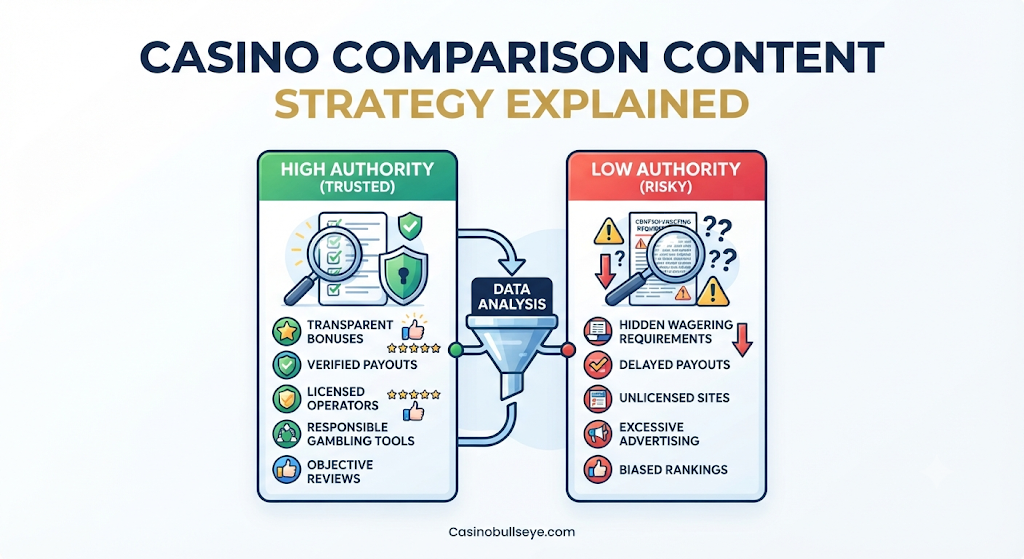
When players make uninformed choices based purely on flashy advertising slogans, they often fall victim to predatory terms, delayed withdrawals, or unlicensed operations. A robust content strategy protects consumers by highlighting hidden risks, explaining fine print, and promoting responsible gambling tools.
How a Casino Comparison Strategy Works
Building and executing an effective comparison strategy requires a repeatable workflow that moves from market research to data collection, structuring, and continuous auditing.
[Market Research & Compliance Check]
       ↓
[Data Collection & Hands-On Testing]
       ↓
[Content Structuring & Objective Scoring]
       ↓
[Continuous Auditing & Regulatory Updates]
1. Market Research and Compliance Screening
Before any content is written, publishers must map out the legal landscape. Regulations vary heavily by region (such as UKGC guidelines in the United Kingdom, state-by-state rules in the US, or international frameworks like Curacao and Malta). A proper strategy identifies which markets the content targets and ensures that only licensed, legal operators are featured.
2. Hands-On Testing and Data Verification
Unlike basic product reviews, a strong comparison strategy relies on firsthand verification. Writers and reviewers should test the user journey by:
- Creating an account and verifying identity (KYC process).
- Depositing funds using standard banking methods to check speed and fees.
- Testing customer support responsiveness via live chat and email.
- Requesting a withdrawal to measure actual payout timelines.
3. Structuring and Objective Scoring
Data is then organized into clear frameworks, using standardized grading criteria. For instance, a platform might be scored out of 100 points based on weighted categories: Safety & Licensing (40%), Payout Speed (20%), Game Variety (20%), and Bonus Value (20%).
Key Components of High-Performing Comparison Content
To deliver true value to readers, comparison content must go beyond surface-level marketing fluff. Successful pages incorporate several essential elements.
| Component | Purpose | What to Include |
| Comparison Tables | Quick decision-making | Side-by-side specs: minimum deposit, payout speed, bonus match, and licensing body. |
| Bonus Breakdown | Transparency | Clear math on wagering requirements ($X bonus × Y playthrough = total bet required). |
| Payment Guides | Practical utility | Detailed lists of deposit/withdrawal limits, fees, and processing times. |
| Regulatory Status | Safety assurance | Explicit verification of active licenses with clickable links to regulatory registries. |
Practical Examples: Evaluating Bonus Offers
Consider two different welcome promotions advertised by online platforms:
- Platform A: Offers a 300% match up to $3,000 with a 50x wagering requirement on both the deposit and the bonus.
- Platform B: Offers a 100% match up to $200 with a 25x wagering requirement on the bonus only.
A naive reader might immediately choose Platform A because the headline number is larger. However, an expert comparison strategy uncovers the hidden math:
$$\text{Total Playthrough Requirement} = (\text{Deposit} + \text{Bonus}) \times \text{Wagering Multiplier}$$
For Platform A, clearing that bonus requires an enormous volume of bets, making it statistically unlikely that the player will retain any winnings. A quality comparison article explains this trap clearly, steering users toward Platform B if their bankroll is modest or explaining the true cost of high-roller bonuses.
Common Mistakes in Casino Content Strategy
Many publishers fail in the iGaming space because they rely on shortcut tactics rather than authoritative content.
- Mistake: Copying bonus terms and promotional text directly from operator marketing sheets without independent verification.
- Why it fails: Terms change rapidly, and outdated information erodes reader trust instantly.
- Instead: Implement a monthly content audit schedule to verify all active promotions, payment methods, and regulatory statuses.
- Mistake: Hiding affiliate relationships or failing to disclose how the site makes money.
- Why it fails: Violates FTC guidelines and destroys transparency.
- Instead: Provide a clear, upfront editorial policy and affiliate disclosure explaining that recommendations may earn commissions without altering objective scoring.
- Mistake: Ignoring responsible gambling resources.
- Why it fails: Promotes unsafe behavior and signals low editorial quality to search engine algorithms.
- Instead: Integrate prominent problem-gambling helplines and self-exclusion tools across all comparison hubs.
Risks and Limitations
Operating or publishing within the casino comparison niche involves unique operational risks:
- Regulatory Shifting: Laws governing online gambling and affiliate marketing change frequently. A strategy must remain flexible enough to pause or remove content when local laws tighten.
- Operator Instability: Unlike traditional e-commerce products, online casinos can occasionally delay payouts or face sudden regulatory action. Relying on a single brand for primary revenue creates major business vulnerability.
- Algorithm Volatility: Search engines treat YYour Money or Your Life (YMYL) niches with extreme strictness. Content that lacks demonstrated experience, expertise, authoritativeness, and trustworthiness (E-E-A-T) will struggle to rank.
Decision-Making Framework for Selecting Casino Partners
When building out a comparison portfolio or deciding which operators to feature, publishers should apply a strict evaluation filter:
- Verify the License: Is the operator licensed by a reputable tier-1 or tier-2 regulator (e.g., MGA, UKGC, NJDGE)? If no verifiable license exists, exclude the platform immediately.
- Audit Payment Reliability: Do they support recognized, secure payment rails (Visa, Mastercard, PayPal, major crypto networks), and are withdrawal complaints minimal?
- Assess Support Quality: Is customer service available 24/7 via human agents, or is it restricted to unhelpful automated chatbots?
- Evaluate Responsible Gaming Tools: Does the operator make it easy for users to set deposit limits, take cooling-off periods, or self-exclude?
- Check User Sentiment: What do real players on independent forums say about their actual cashout experiences?
Key Terms
- Affiliate Marketing: A revenue model where a comparison site earns a commission when a user clicks a referral link and registers or deposits at an operator.
- House Edge: The mathematical advantage that the casino holds over players across various games over the long term.
- KYC (Know Your Customer): The mandatory identity-verification process where players submit ID and proof of address before withdrawing funds.
- Return to Player (RTP): The theoretical percentage of all wagered money a slot or game will pay back to players over time.
- Wagering Requirement: The number of times a player must playthrough bonus funds before converting them into withdrawable cash.
- YMYL (Your Money or Your Life): Content categories (like finance and gambling) that can directly impact a user’s financial stability, health, or safety, requiring exceptionally high E-E-A-T standards.
Frequently Asked Questions
What is the main goal of a casino comparison site?
The primary goal is to help players make informed, safe, and objective decisions by contrasting different online gambling platforms based on licensing, payout speed, bonus fairness, and user experience.
Why is transparency important in casino content strategies?
Because real money is involved, readers and search engines require absolute honesty regarding affiliate relationships, bonus terms, and potential financial risks to protect consumers from predatory practices.
How often should casino comparison content be updated?
Bonus offers, payment limits, and regulatory statuses change constantly. Content should be audited and refreshed at least monthly to ensure complete accuracy.
Can an online casino pay to rank higher on a comparison site?
Ethical comparison sites separate editorial ratings and objective scoring from commercial partnerships. While featured placement or banner spots may be monetized, review scores and rankings should always reflect genuine testing and performance.
What makes a casino bonus “good” or “bad”?
A good bonus features low wagering requirements (e.g., 20x to 35x) applied only to the bonus amount with reasonable game weighting. A bad bonus often features massive headline numbers tied to restrictive 50x+ wagering requirements on both deposit and bonus funds.
Conclusion
A successful casino comparison content strategy relies on a delicate balance between commercial viability and strict consumer protection. By prioritizing factual accuracy, transparent bonus breakdowns, robust compliance checks, and clear responsible gambling resources, publishers can build lasting authority in a competitive vertical. Ultimately, the most effective comparison strategy is one that puts the reader’s safety and informed decision-making above short-term affiliate gains.
