Introduction
A news item is published at nine in the morning. By noon, several outlets have repeated it under new headlines. By evening, it has been quoted in dozens of posts and messages, some accurate, some trimmed, and some already out of date. Meanwhile, a smaller report with real consequences for readers may be sitting several screens down, unnoticed.
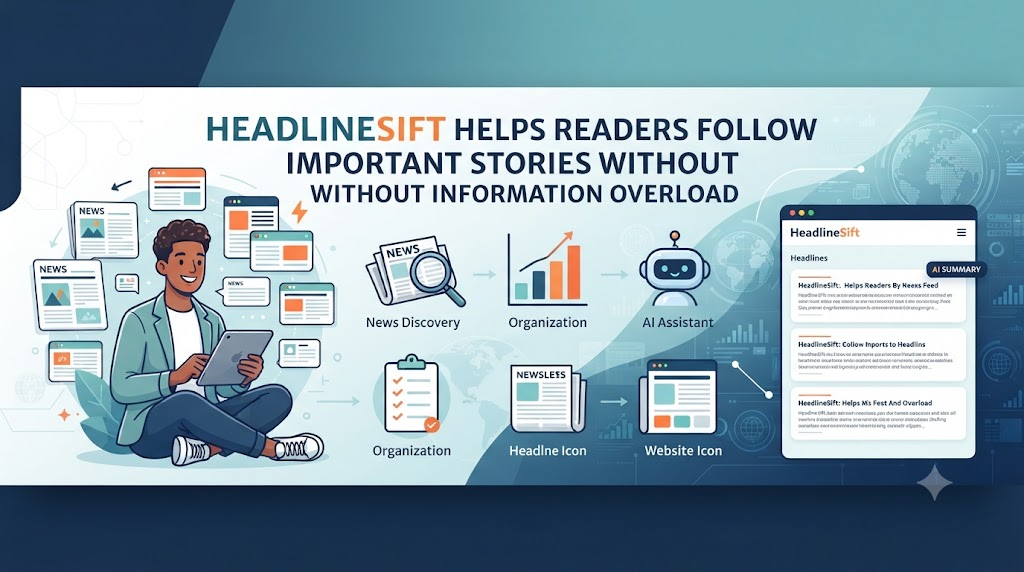
This pattern is familiar to anyone who tries to keep up with current events. Organized news discovery offers a practical remedy. Headlines from many publishers appear in one place, related stories are grouped, and short summaries help readers decide what deserves a full read. HeadlineSift is a platform built around this approach. It is an AI-powered service that collects headlines from hundreds of news sources and arranges them by country and category.
This article explains how such a platform works, what AI summaries can and cannot do, and how readers can build careful habits around them. It also looks at the needs of professionals who manage online content and must check facts before they rely on or repeat any report.
The Purpose of HeadlineSift and the Readers It Serves
HeadlineSift is a news discovery service. It does not write its own reporting. Its function is to gather headlines from various publishers, use AI to merge duplicate coverage, and order stories by their apparent significance. Readers can narrow the list by country and by category, and the platform offers different ways of viewing it, including top ranked, latest, most covered and high impact, with filters for time periods.
Its categories include technology, business and economy, finance and stock market, health and wellness, science and space, education and careers, and breaking news. Some categories carry short cautionary notes. For example, finance stories are marked as informational only, technology stories note that product and company details can change after publication, and education and careers stories remind readers to verify deadlines and eligibility with the official source.
The platform can serve many kinds of readers:
- Content and marketing teams who track developments in their field
- Business owners and managers who follow industry and economic news
- Students and researchers who need a quick view of current affairs
- Anyone who prefers a structured scan to open-ended browsing
Reading news this way involves three separate steps, and each has a different job. Finding a story tells you that something has been reported. Reading a summary tells you what the report is mainly about. Visiting the original article lets you see the evidence, the wording and the context for yourself.
HeadlineSift shows the publisher’s name and a link to the original report with every story. It also provides pages that explain the limits of its AI summaries, how sources are credited, and how issues or removal requests can be raised. This article describes the platform only within what it states publicly.
Why the Daily News Flow Feels Overwhelming to Many People
Not everyone finds the news tiring, but several causes are widely shared.
- Repetition crowds out variety. The same announcement can appear in dozens of near-identical posts.
- Headlines are compressed. A title such as “New norms come into force” says little about who is affected.
- Details arrive in stages. A first report is often followed by corrections and additions.
- Different reports stress different facts. Comparing them takes time and attention.
- Priorities are hard to set. When every story is presented as urgent, readers struggle to choose where to begin.
Consider someone who manages a website and hears that a platform has changed its rules. A quick search returns a long list of articles. Most repeat the first paragraph of the same announcement. Only one or two explain what site owners must do and by when. Locating those two is the real task, and it is the one that ordinary searching handles poorly.
The Building Blocks of AI-Supported News Discovery
Collecting Headlines From Many Publishers With AI Support
An AI news aggregator gathers headlines from a wide set of publishers and places them in one view. The software can group items by subject, location, recency or the event they describe. When several outlets report the same development, the system can merge them so that the reader sees one story and not a dozen versions. HeadlineSift states that it follows hundreds of sources and uses AI to merge duplicate coverage.
Readers should keep one point in mind. Many articles on one subject may all trace back to a single press release, and a government announcement repeated by twenty outlets remains one announcement. Having many sources in one place saves time, but it does not confirm accuracy or independence.
Shortening Long Reports Into Key Points Using AI
An AI news summarizer condenses a long article into its main points. Imagine a detailed report about a new flyover. A useful summary would hold on to three facts: what is being opened, which junction it serves, and the date traffic is expected to use it, along with any temporary diversions.
For busy readers, this makes it possible to review a large number of stories in a short time and open only the relevant ones.
Every summary involves trade-offs, however:
- Exceptions and conditions may be removed to keep the text short.
- Words that signal uncertainty, such as “tentative” or “subject to approval,” can disappear.
- Context that explains why a decision was taken may not survive.
- Automated systems sometimes misunderstand the original wording.
The platform itself shows that summaries are not always ready, since some stories carry a note saying AI analysis is still pending. A summary is a guide to the story, not a replacement for it. Whenever the details matter, the full report should be read.
How Headlines Are Prioritized and Displayed to Readers
Curated news headlines are headlines that have been picked and arranged on purpose. A platform may consider relevance, recency, source information and the apparent significance of an event when deciding what appears first.
Importance and popularity are not the same. A widely shared video may collect millions of views in a day, while a revised public safety notice may matter far more and be read by far fewer people. Clicks measure curiosity. They do not measure value or reliability.
HeadlineSift says it ranks stories by significance. The exact method is not described here, and no ranking approach can honestly be called free of bias. The most sensible use of a ranked list is as a starting filter, followed by the reader’s own decision about what to open.
Following Stories as New Details Emerge
Many stories are not finished when they first appear. Take a product recall. The first report may name a single batch. A later report may widen the list, and a third may add instructions from the manufacturer.
A breaking news aggregator lets readers view how several publishers are describing a developing event at the same moment. Looking at their headlines together shows which facts are shared and which appear in only one report. It cannot guarantee that any of them is correct, and this article makes no claim about alerts or promised update timing.
A few steady habits help more than any feature:
- Check when a story was first published and when it was updated. HeadlineSift displays how recently each story was updated.
- Read cautious phrases such as “initial findings” and “yet to be verified” as real signals.
- Return to the publisher’s page later to see whether corrections were made.
- Hold back from forwarding anything that rests on unconfirmed details.
Understanding News Events in a Global Setting
Events in one country often reach others through trade, regulation, technology and prices. A global news aggregator supports awareness of this by bringing reports from many regions into a single place. HeadlineSift allows readers to browse by country, including India, Japan, the United Kingdom and the United States, as well as a global view.
Context changes how a story should be read. A new data rule in one region may seem like a local matter, yet it can affect companies elsewhere that serve customers there. A report written for readers in one country may also assume background knowledge that outsiders do not have.
No single report captures an international event completely. On subjects that are serious or disputed, it is wise to read reliable publishers from more than one country.
Following Digital Innovation and AI Developments Clearly
The language of technology coverage can be dense, and claims often move faster than evidence. A technology news aggregator lets readers follow artificial intelligence, cybersecurity, software, cloud services and devices without visiting many separate sites.
Four kinds of information often appear together, and it helps to separate them:
- A maker’s statement describes the product as its creator wants it understood.
- A research summary reports what a study found under defined conditions.
- An independent review or audit shows what an outside party observed.
- Expert commentary adds informed judgment, which is still opinion.
Suppose a startup says its app is “private by design.” That is a claim. An independent security audit or a third-party test would be stronger evidence. Readers who keep these categories apart judge technology stories more accurately.
Reading Company and Industry News in Full Context
Business coverage includes partnerships, leadership changes, earnings, expansion plans and shifts across whole industries. A business news aggregator brings these reports together so a reader can follow one sector or compare how different publishers describe the same announcement.
A headline seldom contains everything. “Two firms announce partnership” does not tell you the scope of the work, how long it will last, or what the financial terms are. The full article or the companies’ own statements are where those answers appear.
Business reporting records what has been announced. It does not forecast what will follow. Facts should be confirmed before a view is formed, and assumptions about a company’s future should be avoided.
Interpreting Market and Economic Headlines Sensibly
Financial news headlines may deal with equity markets, interest rates, inflation, government policy, company results and commodity prices. They are written quickly and invite over-reading.
Consider a change in the price of gold. It might reflect currency movements, changes in interest rate expectations, demand from buyers, or tension in the wider world. A single headline usually points to one reason, though several often operate together.
A news summary is not a personal investment recommendation. It cannot consider anyone’s goals, finances or appetite for risk. HeadlineSift marks its finance stories as informational only, and readers should treat them that way. No news source can promise returns or predict where a market is heading.
Considering the Wider Consequences of Major Events
News impact analysis helps readers think about why an event matters and who it may touch. It is most useful when it encourages a clear set of questions:
- What has happened?
- What is confirmed so far?
- Who may be affected?
- What could follow?
- What is still unknown?
The key discipline is to keep verified facts and possible consequences apart. “A new labeling rule for packaged food was announced” is a fact. “Manufacturers may need to change their packaging, and prices could shift” is a possible consequence. AI-generated analysis can help frame the second statement, but it remains an interpretation and not a certainty. HeadlineSift cannot predict outcomes, and no tool can measure the effect of every event accurately.
Following Subjects That Fit Your Own Interests
News is more useful when it matches what a person needs to know. A parent may follow school and admissions updates. A freelancer may track new digital tools and payment rules. A small manufacturer may watch trade news and input prices.
A personalized news digest is a selection of stories assembled around the interests of one reader. HeadlineSift describes this as a future direction, so it should not be treated as a current feature. For now, readers can approximate part of the benefit by choosing a country and a category and returning to them regularly.
Personalization carries its own risks wherever it appears. A feed shaped only by earlier choices can hide viewpoints and events that a reader would have wanted to see. It may make reading easier, but it does not remove bias and does not replace looking beyond familiar topics.
Why Readers Benefit From Visible Sources and Original Reports
A reader should be able to tell who published a story and where the full report can be found. This matters because the pieces of content that sit side by side in a news feed are not the same kind of thing.
An original news report is produced by a newsroom and usually carries a byline or publication credit. A summary is a shortened account of someone else’s work. An opinion article tells you what the writer thinks, not only what happened. An AI-generated explanation is software’s reading of the material and can contain mistakes.
HeadlineSift shows the publisher’s name and links to the original report for each story, so readers can trace a claim to its place of origin. A link does not prove that a claim is true, because publishers can be wrong and important statements may need to be checked against other reliable reports. Naming the source makes checking possible, but it does not do the checking.
A Clear Five-Step Approach to Reading News Effectively
- Choose a headline within your interest. Use country and category filters to keep the list focused, which also keeps your time under control.
- Read the summary. It tells you the central point and whether more reading is needed.
- Look at the date and the publisher. Old items can look new, and unfamiliar sources need extra attention.
- Compare reliable reports on important stories. Two or three sources show where reports agree and where they diverge.
- Read the full article before acting. Do not publish, share or decide on the basis of a summary alone.
Mistakes Readers Should Avoid With AI-Summarized News
- Stopping at the summary. Use it to choose what to read, and go to the report for detail.
- Accepting a headline without the evidence. Headlines are short by design, so check the text beneath them.
- Treating AI interpretation as established fact. Ask who stated it and whether it appears in the publisher’s own report.
- Mistaking repetition for confirmation. See if the articles lean on one shared statement.
- Overlooking dates and revisions. Confirm when a story was posted and whether newer information exists.
- Reading finance stories as personal advice. News describes events. Financial choices should reflect your own situation and, where suitable, qualified guidance.
- Passing on developing reports too soon. Wait until the main facts are confirmed.
A Simple Hypothetical Example
Imagine Ananya, who runs a small online business that depends on a third-party service. One afternoon she sees a headline saying the service is investigating unauthorized access to user data.
She reads the AI summary. It says unauthorized access has been reported and an investigation is under way. That gives her the central point, but it does not say whether her account could be involved.
Ananya then opens the original report from the publisher. The article quotes a company statement saying that unusual activity was detected, that a limited number of accounts may be affected, and that users should reset their passwords as a precaution. The statement does not say what kind of data was involved. The summary had left out that limit.
Next, she looks for a second reliable report on the same subject. It repeats the company’s statement and adds a comment from an independent security analyst, who says it is too early to know the scope. Ananya notes that the company’s statement is the only primary source for both reports.
She can now separate what is known from what is not. The company has confirmed that it is investigating suspicious activity and has advised a precaution. The number of accounts, the type of data and the cause are not confirmed. Misuse of data or service disruption would only be possible effects. Ananya resets her password by typing the service’s official address herself instead of following a link in a message, turns on any extra login protection offered, and waits for official updates. She used the summary to save time and the original sources to act with care.
Questions and Answers for Careful News Readers
How can content teams use summaries before publishing something?
Treat a summary as a screening tool. Before repeating a fact, confirm it in the original report, give credit to the publisher, and link to the source rather than copying its text.
Why do publishers use different headlines for the same story?
Each newsroom makes its own editorial choices about emphasis and wording. Headlines may also change as a story is updated, which is another reason to read the full report.
What is the difference between a press release and a news report?
A press release is a statement from the organization itself. A news report is written by a journalist, who may add checking, questions and outside views. Both are useful, but they are not the same kind of source.
How should I treat numbers that appear in a headline?
Look for where the figure came from, the date it applies to, and how it was measured. A number without its source or time frame can easily mislead.
What does source attribution actually protect against?
It helps readers trace a claim to its origin and see who is responsible for it. It does not prove that the claim is correct.
Can an AI platform decide which news is important for everyone?
No. A significance ranking is a general guide. What matters most depends on a reader’s location, work and interests, so it is worth using filters and your own judgment.
How can I tell when a story has been updated?
Look at the time shown on the story and any “updated” label from the publisher. HeadlineSift shows how recently a story was updated, and the original article may include editor’s notes.
How much time should one story deserve?
It depends on what is at stake. A passing interest may need only a headline and a summary. A matter affecting work, money, safety or reputation deserves full reports and a second source. A personalized news digest, which HeadlineSift describes as a future direction, would not change that principle.
Concluding Thoughts
Reliable understanding seldom comes from one headline, one summary or one website. It comes from a short routine: find the story, read the summary for direction, check the date and the publisher, and compare when the stakes are high. HeadlineSift supports the first part of that routine by collecting headlines from many outlets, offering brief AI summaries, and linking to the original reports so readers can complete the rest. With these habits, a crowded news feed becomes easier to manage, and decisions rest on facts that have been checked.
