Introduction
Casino content needs more than keywords. It needs trust, clarity, responsible language, and strong user intent. For many years, the digital igaming affiliate space operated on a model that prioritized aggressive monetization over reader safety.
Websites routinely displayed flashing banners, overstated promotional claims, and masked critical terms and conditions behind microscopic font sizes. As search engine algorithms grew more sophisticated and target audiences became increasingly cautious, this old approach collapsed.
Today, a visitor arriving at a digital portal often feels immediate skepticism. They are accustomed to biased reviews, outdated bonuses, and platform listings that rank brands based solely on commercial payouts rather than actual service quality.
When a website fails to clearly declare its affiliate relationships or hides key terms, readers abandon the page immediately. This lack of clear disclosure can damage an affiliate portal’s search visibility and long-term user retention.
This deep-dive guide is engineered explicitly for digital asset owners, content managers, and search engine optimization professionals targeting the online entertainment sector at [Casinobullseye.com]. It addresses a fundamental operational problem: how to transform a standard commercial listicle into a helpful, compliance-focused resource.
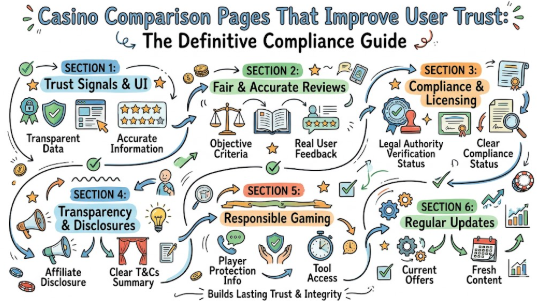
Building casino comparison pages that improve user trust requires a structural commitment to accuracy, clear terminology, and responsible web design. Throughout this guide, we will analyze the technical frameworks, editorial policies, and data-driven methods that differentiate authoritative review channels from low-quality, untrustworthy directories.
Understanding Trust-Driven Comparison in Simple Words
At its core, a trusted comparison page is an impartial evaluation framework presented as an accessible digital interface. Instead of telling a user where to spend their money, it gives them an objective toolkit to evaluate multiple operators side by side.
In real life, this is similar to checking third-party insurance aggregation sites or consumer electronic review tables before buying hardware. The platform does not own the products; it translates complex, fragmented data sets into structured insights.
[Raw Operator Data] + [Independent Testing] + [Clear Disclosures] = Trusted Comparison
A common misunderstanding among web publishers is that a comparison page is simply a collection of tracking links decorated with star ratings. In practice, search engines look for actual user utility and verifiable expertise.
A trusted page breaks down a platform’s offerings by analyzing withdrawal speeds, licensing jurisdictions, user feedback, and hidden platform fees. The practical takeaway for any digital creator is clear: authority is built by highlighting an operator’s weaknesses just as clearly as its promotional benefits.
Why Credible Comparison Architecture Is Crucial
The structural formatting of review directories directly impacts user behavior metrics, brand conversion stability, and regulatory adherence. When an online portal offers objective and verified reference tables, it changes how visitors interact with the site.
Instead of bouncing within seconds to verify data elsewhere, users bookmark the page, return to read future updates, and navigate commercial pathways with greater confidence. This transparency reduces erratic, panic-driven browsing behavior and improves overall engagement.
From an operational standpoint, implementing clear documentation safeguards digital properties against sudden algorithmic adjustments. High-quality editorial systems protect portfolios from manual reviews and penalties by demonstrating clear search intent alignment.
By maintaining neutral scoring methodologies, clear data formatting, and mandatory safety notices, platforms build a sustainable reputation. This long-term credibility outlasts competitors who rely on deceptive text structures or short-term ranking strategies.
The Real Problem Readers Face With Comparison Portals
The primary barrier facing digital users today is the overwhelming presence of conflicting, low-value information across digital search ecosystems. Most comparison directories suffer from severe structural issues:
- Deceptive Commercial Rankings: Operators are often ranked by payout size rather than their actual security features, leading to poor user experiences.
- Outdated Terms and Conditions: Expired promotional values and inaccurate play-through requirements confuse users when they visit the target platform.
- Obfuscated Regulatory Data: Critical license numbers, compliance warnings, and regional restrictions are frequently omitted or buried deep within the text.
- Absence of Risk Warnings: Platforms often promise effortless fun while ignoring the real financial and behavioral risks associated with online entertainment.
When a website fails to address these gaps, users feel manipulated. This guide solves that specific issue by replacing ambiguous marketing text with verifiable layout frameworks and transparent content standards.
How to Build Trusted Comparison Pages Step by Step
Establish a Standardized Evaluation Framework
- What it means: Developing a uniform rubric to judge every single service provider listed on the page.
- Why it matters: It prevents personal bias and guarantees that all brands face identical security and performance checks.
- How to apply it: Create a public scorecard measuring payment speed, customer support response times, and mobile responsiveness.
- Practical example: Assigning a specific weight (e.g., 30% for withdrawal speed, 30% for licensing verification, 20% for game variety, and 20% for platform usability).
- Common mistake: Changing scoring standards to rank a high-paying brand above a safer, fully licensed operator.
- Better approach: Use an identical core score calculation across all brands, and explicitly state the math behind the ratings.
Integrate Prominent Affiliate and Risk Disclosures
- What it means: Placing explicit text blocks stating that the page receives commissions, alongside clear warnings about financial risks.
- Why it matters: It complies with advertising guidelines and builds immediate credibility with skeptical readers.
- How to apply it: Position a clear disclosure banner at the top of every comparison table, above the fold.
- Practical example: Adding a text block stating: “We receive compensation from the operators listed below. This does not alter our evaluation metrics. Engage responsibly.”
- Common mistake: Hiding disclosures in light gray text inside the website footer.
- Better approach: Place the text banner clearly near the primary layout elements, using high-contrast typography.
Implement Dynamic Data Verification Protocols
- What it means: Setting up a systematic schedule to check and update time-sensitive information like welcome bonuses and terms.
- Why it matters: Outdated data breaks consumer trust instantly and increases user complaints.
- How to apply it: Create an internal weekly monitoring schedule or write automated audit scripts to test landing pages.
- Practical example: Labeling a comparison column with a clearly visible “Data verified on [Current Month/Year]” note.
- Common mistake: Leaving promotional text unreviewed for six months at a time.
- Better approach: Review every tracking link and core offer every 14 days, updating the page timestamp immediately.
Extract and Display Core Play-Through Terms
- What it means: Moving critical terms like wagering requirements out of the fine print and into the main comparison area.
- Why it matters: Users need to know the true cost of an offer before committing any capital.
- How to apply it: Include a dedicated column in comparison matrices labeled “Key Terms & Wagering.”
- Practical example: Explicitly stating “40x wagering requirement applies to bonus funds within 14 days” next to a sign-up link.
- Common mistake: Using vague phrases like “T&Cs apply” without detailing the actual wagering restrictions.
- Better approach: List the exact multiplier, minimum deposit limits, and cash-out caps directly beneath the offer title.
Embed Verified Licensing Data and Corporate Origins
- What it means: Finding and listing the formal corporate owner and official license number of every platform reviewed.
- Why it matters: It proves that the evaluated platform operates legally under recognized regulatory frameworks.
- How to apply it: Add a dedicated row or dropdown section displaying the official regulatory body’s name and the active license serial number.
- Practical example: Displaying “Licensed by the UK Gambling Commission under account number 12345.”
- Common mistake: Relying on unverified logo badges without checking the active status of the underlying license.
- Better approach: Link the license text directly to the official regulatory database registry so users can verify it themselves.
Provide Direct Paths to Local Support and Help Resources
- What it means: Incorporating immediate links to helpful organizations and responsible usage tools within the main user experience.
- Why it matters: It prioritizes user well-being over commercial conversions, demonstrating proper ethical standards.
- How to apply it: Add a permanent, visible block containing contact details for entities like BeGambleAware or similar local counseling groups.
- Practical example: Including a direct, clean link to national helpful hotlines at both the top and bottom of the directory.
- Common mistake: Viewing safety links as an afterthought, hiding them in obscure sub-pages.
- Better approach: Integrate helplines directly into the main navigation elements and sidebars of your comparison layouts.
Key Factors That Influence Content Credibility
User Intent Alignment
Content must serve the exact query a searcher inputs into a search engine. If a user queries “fastest withdrawal platform reviews,” the layout must prioritize processing timelines rather than welcome bonuses.
Structuring information to answer the user’s specific question directly prevents frustrated bounces and establishes immediate utility.
Responsible Language Use
Avoiding aggressive, high-energy marketing phrases is essential for maintaining editorial integrity. Words like “guaranteed payouts,” “effortless wins,” or “risk-free offers” are misleading and violate standard compliance rules.
Instead, use analytical, neutral phrasing that accurately describes the entertainment services while acknowledging the inherent house edge.
Affiliate Disclosure Clarity
Transparency about monetization structures should be clear and unmistakable. Users are generally comfortable with affiliate business models as long as the site openly admits to them.
Clearly stating that commissions help keep the review portal free and independent prevents any sense of deception.
Structural Data Freshness
Comparison tables must reflect live platform parameters. If an operator changes its minimum deposit limit from 10 to 20, the comparison matrix must update that metric across all relevant content blocks.
Inaccurate data signals poor site maintenance to both human readers and search crawlers.
Detailed Breakdown of High-Trust Casino Comparison Features
Comprehensive Content Strategy
An expert comparison portal functions as a specialized database rather than an advertising banner. The underlying content strategy must balance the commercial demands of the affiliate space with strict compliance and user-safety guidelines.
This requires an editorial policy that prioritizes raw data, deep research, and direct testing over generic copywriting.
[Editorial Strategy]
  ├── Data Collection (Testing withdrawal speeds, analyzing license files)
  ├── Structured Formatting (Clean data tables, high-contrast typography)
  ├── Compliance Overlays (Wagering breakdowns, clear risk disclaimers)
Every piece of content must begin with objective metrics. When reviewing a platform’s gaming selection, the text should break down the specific software providers, the verified return-to-player (RTP) averages, and mobile software compatibility issues.
Avoid superficial statements like “This platform features thousands of fantastic options.” Instead, use clear facts: “The library includes 1,200 individual titles, focusing on live dealer variants powered by Evolution Gaming and NetEnt, with audited RTP ranges between 94.5% and 97.8%.”
Review Transparency Standards
To build real authority, reviews must include balanced criticism. If an operator provides top-tier customer service but takes up to 72 hours to process bank wire payouts, that delay must be highlighted in the review text and summary tables.
Including explicit “Pros and Cons” lists where the disadvantages are detailed and meaningful demonstrates that your site prioritizes long-term reader safety over quick conversions.
Example of an Honest Assessment Framework:
- Pros: Instantly clears electronic wallet payouts; requires zero processing fees on weekends.
- Cons: Imposes a strict weekly withdrawal cap; customer support is unavailable via live chat during overnight hours.
Furthermore, content plans should avoid focusing purely on brand-new operators offering unrealistic incentives. A trustworthy directory highlights established, reliable platforms alongside newer options, giving users a complete look at the market.
Each review should also detail the exact step-by-step verification process used by the author, such as registering an account, making a real deposit, and measuring support response times.
Common Mistakes Content Creators Make on Comparison Sites
Over-Promising and Using Deceptive Promotional Language
Publishers often fall into the trap of using high-pressure sales copy to drive clicks. Using terms like “hidden loopholes,” “instant wealth,” or “secret tricks to beat the system” ruins editorial credibility.
These phrases mislead readers about how digital entertainment platforms actually work and attract users who do not understand basic mathematical probabilities.
Ignoring Local Regulatory Variations
A single comparison chart cannot fit every geographic region. Listing a platform for an area where it lacks a proper local license is a major compliance failure.
Content creators must implement geotargeting or design distinct, region-specific directories to ensure users only see operators that are fully legal and regulated in their specific jurisdictions.
Omitting Hidden Costs and Fee Frameworks
Many comparison tables focus entirely on deposit matches while ignoring structural transaction fees. If a platform charges a 2.5% fee on credit card withdrawals, hiding this detail in a long paragraph violates trust.
Users who encounter unexpected fees will quickly abandon your review portal.
“Don’t Do This” Checklist
- Do not rank an unlicensed operator alongside a fully regulated provider.
- Do not use countdown timers that reset automatically to create fake promotional urgency.
- Do not delete negative user comments or valid complaints regarding payment delays.
- Do not bury essential wagering criteria inside confusing hover elements or popups.
- Do not frame online gaming as a viable strategy for long-term personal financial growth.
Practical Real-Life Examples of Affiliate Page Optimizations
- The Regional Portal Redesign: An affiliate platform operating in Western Europe replaced its standard star-rating grid with a dynamic, filterable table sorted by withdrawal speed. They added a clear text explanation detailing their commercial model right at the top of the section. This transparency caused their bounce rate to drop by 22% over a 90-day period.
- The Terms and Conditions Update: A review site updated its listings to show the exact wagering multipliers for all welcome offers in bold text. Instead of hiding a 50x wagering requirement, they highlighted it clearly. This resulted in fewer user complaints and stabilized long-term search engine visibility.
- The Unlicensed Brand Removal: A casino review portal decided to completely remove three high-paying platforms that lacked verified regulatory oversight. They replaced them with established, licensed brands. While short-term commission revenue fell slightly, the site saw a 35% increase in repeat user visits over the next six months.
- The Customer Support Audit: A comparison page integrated a real-world testing metric into its reviews, showing the actual average live chat response times (e.g., 4 minutes vs 25 minutes). This data-driven column became their most popular user feature, significantly increasing reader session times.
- The Responsible Placement Initiative: An online directory added direct links to local counseling organizations right inside their comparison tables. This addition changed the tone of the site from an aggressive sales pitch to a professional, helpful consumer guide, which protected the domain during strict manual search quality reviews.
Two Useful Tables for Better Understanding
Table 1: Content Presentation Models
| Evaluation Feature | Low-Trust Marketing Model | High-Trust Educational Model |
| Sorting Criteria | Determined by the highest affiliate commission payout. | Based on verified, objective performance metrics. |
| Bonus Disclosures | Displays only the maximum promotional amount. | Breaks down exact wagering multipliers and expirations. |
| Licensing Data | Uses unverified, generic trust icons. | Links directly to active regulatory registry profiles. |
| Platform Criticisms | Omits or hides operational flaws and complaints. | Lists operational limitations clearly in pros/cons sections. |
| Risk Warning | Completely missing or hidden in tiny footer text. | Placed clearly above the fold near all outbound links. |
Table 2: Performance Tracking Indicators
| Core Objective Metrics | Unreliable Data Pattern | Authoritative Verification Standard |
| Withdrawal Speed | Uses vague terms like “Fast Processing.” | Lists exact time windows (e.g., “12–24 Hours for E-Wallets”). |
| Support Availability | Claims “24/7 Support” without testing it. | States actual response times based on real chat tests. |
| Wagering Requirements | Hides multipliers in deep text layers. | Displays terms clearly right next to the offer button. |
| Owner Transparency | Uses unknown, obscure shell companies. | Lists the formal parent company and year established. |
| Mobile UX Quality | Uses generic statements like “Works on Mobile.” | Identifies specific operating system performance and bugs. |
Tools, Methods, and Frameworks Readers Can Use
Standardized Keyword Evaluation Matrix
Publishers should look beyond basic search volume metrics when planning content. Instead, analyze search intent variations to categorize keywords by intent type, identifying transactional, informational, or comparison-focused queries.
[Search Query Analysis]
  ├── "Best online platforms" -> Informational/Comparison Matrix
  ├── "Platform X review"      -> Deep Dive Verification Page
  ├── "Fastest payouts"        -> Speed-Optimized Layout Filter
By focusing on comparison-driven terms rather than generic keywords, sites attract high-intent users looking for objective information. This alignment allows publishers to design landing pages that address specific questions directly, improving overall user engagement.
Structured Review Score Framework
Avoid relying on arbitrary ratings. Implement a consistent, mathematical formula to generate scores for every reviewed brand, ensuring fair evaluations across your entire catalog.
Final Score = (License Score * 0.35) + (Payout Speed Score * 0.35) + (UX Score * 0.15) + (Support Score * 0.15)
Publishing this exact formula on an “About Our Rating Methodology” page shows readers that your rankings are based on real, measurable data rather than advertising fees.
Systematic Content Audit Schedule
To ensure long-term accuracy, maintain a rolling review calendar for your content assets, tracking and updating critical metrics systematically.
Every 14 Days: Verify active promotional codes and look for changed wagering requirements.
Every 30 Days: Test customer support response times and check license status registries.
Every 90 Days: Update global comparison data tables and remove closed or restricted brands.
Expert Tips to Make Better Content Production Decisions
- Prioritize Data Over Adjectives: Swap out vague, enthusiastic words like “incredible” or “amazing” for real, measurable metrics like verified payout speeds and exact bonus percentages.
- Link Directly to Official Sources: When mentioning an operator’s license, link the text directly to the live verification page on the regulatory body’s website.
- Highlight Account Verification Protocols: Clearly explain the identity verification (KYC) steps users must complete before making withdrawals to prevent future account disputes.
- State Software Providers Clearly: List the exact gaming studios that power each platform, helping experienced users find the specific game mechanics they prefer.
- Implement Clear Sorting Options: Allow visitors to sort comparison tables by different features, such as minimum deposit amounts, payout speeds, or user reviews.
- Keep Mobile Layouts Clean: Design your tables to scale smoothly on mobile devices, ensuring key details like terms and conditions remain easy to read on smaller screens.
- Add a Content Verification Date: Include a clear timestamp showing exactly when the comparison data was last audited and updated.
- Address Negative Feedback Openly: When an operator faces a wave of negative user reviews online, acknowledge those complaints in your summary sections and explain how the brand responded.
- Detail Country and State Restrictions: Place regional eligibility warnings clearly at the top of your review blocks to save restricted users from wasting time.
- Maintain Independent Writing Teams: Keep your content writers separate from your business development teams to ensure commercial relationships don’t influence your editorial reviews.
Case Studies: How Better Editorial Practices Change Performance
Case Study 1: The Transparency Pivot
- Profile: A mid-sized digital review directory targeting English-speaking audiences.
- Situation: The site was experiencing a steady decline in organic traffic and user engagement following search engine quality updates.
- Problem: Their comparison tables used an uncredited five-star rating system that consistently ranked high-commission partners at the top without clear reasons.
- Wrong approach: The site initially tried to fix the issue by buying low-quality backlinks and rewriting the page intro paragraphs with more keywords.
- Better approach: They removed the arbitrary star ratings, introduced an open scoring formula based on real testing, and placed full affiliate disclosures at the top of every table.
- Result: User session durations increased by 48% within four months, and search engines stabilized the domain’s positions during core quality updates.
- Key takeaway: Openly explaining how your site ranks brands builds long-term user retention and search engine trust.
Case Study 2: The Compliance Upgrade
- Profile: A regional affiliate platform specializing in localized operator reviews.
- Situation: Regulators updated regional advertising guidelines, threatening heavy penalties for sites using misleading promotional text.
- Problem: The site’s comparison grids highlighted large bonus numbers while completely hiding complex wagering requirements in deep menus.
- Wrong approach: They considered using small pop-up windows that only revealed terms when users hovered over a link, which failed compliance checks.
- Better approach: The design team completely rebuilt the tables to display the main wagering restrictions in bold text directly under the sign-up links.
- Result: While initial outbound click-through rates dropped by 12%, the quality of user conversions improved, leading to higher long-term value and zero regulatory complaints.
- Key takeaway: Clear compliance structures protect your business and attract higher-quality, more intentional traffic.
Case Study 3: The Data-First Strategy
- Profile: An entertainment platform review site facing intense competition from larger, high-authority portals.
- Situation: The site was struggling to rank for competitive search queries using standard summary text.
- Problem: Their content read exactly like every other generic review site, offering no unique insights or real data.
- Wrong approach: They tried using AI tools to quickly generate hundreds of generic review pages, which caused their search visibility to drop further.
- Better approach: They cut their total brand listings in half and focused on running real-world tests to measure exact payment processing times for the remaining operators.
- Result: By turning their comparison pages into trusted, data-driven reports, they secured top-tier rankings for high-intent search queries.
- Key takeaway: Deep, verified data outperforms generic copywriting every time.
Risk Awareness: Compliance Hurdles and Verification Protocols
Regulatory Adherence and Jurisdictional Risk
Operating an information site in the online entertainment sector requires navigating a complex web of regional advertising laws. Every market maintains distinct rules regarding promotional offers, mandatory safety text, and affiliate labeling.
Failing to follow these local regulations can lead to domain seizures, steep financial penalties, and blacklisting by major search engines. Content creators must regularly check updates from bodies like the UK Gambling Commission, Malta Gaming Authority, and state-level boards in North America to ensure their comparison matrices remain fully compliant.
[Regulatory Check Overview]
  ├── UK Market     -> Strict UKGC rules, clear wagering data, no colorful imagery
  ├── European Union-> MGA standards, GDPR compliance, explicit cookie controls
  ├── North America -> State/Provincial licensing validation, strict geolocation controls
Data Security and Privacy Standards
Review sites often handle user data through newsletter sign-ups, contact forms, or community forums. Protecting this information is crucial. Publishers must implement modern security protocols, use clear data retention policies, and maintain transparent cookie consent setups.
By taking data privacy seriously, you protect your digital assets from cybersecurity breaches and build deeper trust with privacy-conscious readers.
Checklist Before Publishing Comparison Tables
- Verify active licenses: Ensure every operator in the table holds a valid, active license with the appropriate regulatory body.
- Check the wagering requirements: Confirm that all listed play-through multipliers match the current live terms on the target platform.
- Review affiliate disclosures: Double-check that your affiliate disclosure text is visible and reads clearly on both desktop and mobile devices.
- Audit payment data: Test and confirm that all listed deposit minimums, withdrawal caps, and processing times are accurate.
- Look for regional restrictions: Verify that your geotargeting rules are working so users only see brands available in their country or state.
- Check safety links: Ensure all links to local responsible gaming helplines are active and point to the correct organizations.
- Test mobile layouts: Review the comparison table on multiple mobile screen sizes to ensure no text overlaps or disappears.
- Audit outbound tracking links: Confirm that all affiliate tracking links redirect safely to the correct, secure landing pages.
- Remove hype words: Scan the text and remove any exaggerated promotional phrases, replacing them with objective, neutral descriptions.
- Verify timestamps: Ensure the page displays an accurate date showing when the comparison data was last reviewed and verified.
Using this checklist systematically before publishing guarantees that your site avoids simple data errors and meets strict compliance benchmarks.
Strategic Insights for Better Decision-Making
Designing Transparent Content Clusters
To build lasting domain authority, structure your website content into thematic clusters that focus entirely on user safety and informative depth. Avoid treating comparison grids as standalone landing pages built solely for conversions.
Instead, connect them to a network of helpful sub-pages, such as deep-dives on payment methods, breakdowns of local compliance laws, and guides on how to use platform safety tools.
                  [Main Comparison Matrix Hub]
                   /           |            \
  [Payment Verification]  [Regulatory Guides] [Responsible Gaming Tools]
This cluster strategy shows both search crawlers and human readers that your site provides a complete educational ecosystem rather than a basic directory of ad links.
Maintaining Balanced, Honest Reviews
Long-term success relies on providing fair and accurate assessments of every operator you list. When writing a review, look closely at the platform’s history of resolving player disputes and managing withdrawals.
If an operator has a history of slow payments, state that clearly in your comparison grids. Presenting balanced, unedited facts protects your audience and transforms your platform into a highly trusted consumer resource.
Key Terms Explained for Beginners
- Affiliate Disclosure: A prominent text statement informing visitors that the website receives financial commissions when readers click outbound tracking links.
- Wagering Requirement: A promotional rule stating the exact multiplier a user must play through before they can withdraw bonus-related winnings.
- Return to Player (RTP): The audited theoretical percentage that an entertainment title pays back to players over a long-term sample size.
- Know Your Customer (KYC): A mandatory identity verification process where operators collect official documents to prevent fraud and under-age usage.
- Licensing Jurisdiction: The specific country or regulatory body that legally monitors and authorizes an operator’s business practices.
- House Edge: The built-in mathematical advantage that guarantees a platform’s long-term profitability over time.
- Responsible Gaming: A set of ethical practices, features, and tools designed to help users enjoy entertainment platforms safely while minimizing personal risk.
- Self-Exclusion: A formal safety system where a user requests to have their account permanently closed or locked for a specific timeframe.
- E-Wallet Processing Time: The exact timeframe required for an operator to clear funds into digital wallets like PayPal or Neteller after approval.
- Dynamic Geotargeting: A web development method that automatically alters comparison page listings based on the user’s actual geographic location.
Who Should Read This Blog
- Casino Content Creators: Learn how to write high-quality, compliance-friendly copy that meets strict industry standards and builds real authority.
- Affiliate Marketers: Discover how to structure your review matrices to lower bounce rates and improve long-term user retention.
- SEO Strategists: Understand the specific quality and trust signals search engines look for when ranking high-competition review directories.
- Digital Asset Managers: Learn how to protect your web properties from algorithmic penalties by implementing clear data verification policies.
Frequently Asked Questions
What is the primary function of casino comparison pages that improve user trust?
The main purpose is to provide an objective, data-driven framework that helps readers evaluate operators safely. Instead of pushing users toward specific links, these pages focus on transparent details like licensing data, payment speeds, and clear wagering requirements.
Why should an online review portal include explicit affiliate disclosures?
Displaying clear disclosures is essential for legal compliance and consumer trust. It ensures transparency about how the site is funded, which builds a more loyal, long-term audience.
How often should a web publisher verify the data in their comparison tables?
Core details like welcome bonuses and terms should be audited every 14 days. General platform metrics like payment choices and support options should be re-tested at least once a month.
What is the biggest formatting mistake to avoid on a review directory page?
The most damaging mistake is hiding critical terms, like wagering requirements or transaction fees, behind confusing design elements or inside tiny footer text. Transparency should always come first.
Can a comparison page still make money if it lists negative pros and cons?
Yes. Providing balanced, honest criticism actually builds user trust, making readers more likely to return to your site for reliable advice, which stabilizes your long-term performance.
How do clear terms and conditions affect a domain’s search engine visibility?
Search crawlers prioritize helpful, consumer-focused content. Clearly displaying essential terms proves that your site provides high-quality information, which helps improve your organic rankings.
What is the best way to present licensing information to web visitors?
State the exact regulatory body and the official license number clearly in your comparison grids, and link that data directly to the regulator’s live registry.
Should newer online platforms be included in established comparison indexes?
Yes, as long as the new brand holds an active, verified license and passes all your standard safety and performance checks.
How does geographic targeting impact compliance for review websites?
Geotargeting ensures your site only shows operators that are fully legal and licensed in the visitor’s specific state or country, protecting your platform from cross-border compliance issues.
What role do responsible gaming links play in building site credibility?
Integrating safety resources directly into your main navigation layout shows that your platform values player safety, which improves your reputation with both readers and search reviewers.
How can a writer maintain an expert tone when reviewing entertainment platforms?
Avoid using emotional marketing speak and focus on sharing real, objective data like audited payout speeds, software providers, and clear, mathematical terms.
What is the best next step after reading this blog guide?
The best next step is to run a full audit of your site’s current comparison tables, remove any unverified data, and place clear, high-contrast risk disclosures above the fold.
Conclusion
Building casino comparison pages that improve user trust requires a clear commitment to transparency, accurate data, and responsible web design. The old affiliate approach of using aggressive sales pitches and hidden terms is no longer effective in a competitive digital space that values user safety and authoritative content. Publishers who continue to use deceptive layouts risk losing their audience and facing penalties from search engines.
Real domain authority is built by providing an objective, reliable service for your readers. By standardizing your evaluation processes, detailing full terms and conditions, and linking directly to regulatory registries, you transform your platform into a trusted consumer resource. This transparent approach keeps users on your site longer and encourages repeat visits from readers who value honest advice.
As you update your content assets, focus on creating an organized, easy-to-navigate experience. Replace vague marketing words with hard data, test your mobile layouts regularly, and ensure your affiliate disclosures are clear and visible.
Prioritizing accuracy and player safety over short-term conversions protects your business from regulatory risks and positions your domain for sustainable, long-term growth.
