Introduction
Winning money at an online casino is exciting, but requesting your first withdrawal often brings an unexpected roadblock: an email asking for scans of your passport, a recent electricity bill, and pictures of your bank card.
For many beginners, this request feels invasive or alarming. Some players worry the casino is looking for an excuse to keep their winnings. Others find the process confusing and do not understand why a site that accepted their deposit in seconds takes days to approve a cashout.
This friction exists because of a basic rule of the gaming industry: depositing money is easy, but taking money out requires legal accountability. Regulators require licensed operators to prove exactly where funds come from and who receives them.
Understanding the payment verification process in casinos removes the guesswork. When you know what casino security teams look for, which documents satisfy their checks, and which mistakes trigger red flags, you can prepare ahead of time and collect your payouts without unnecessary delays.
What Is the Payment Verification Process in Casinos?
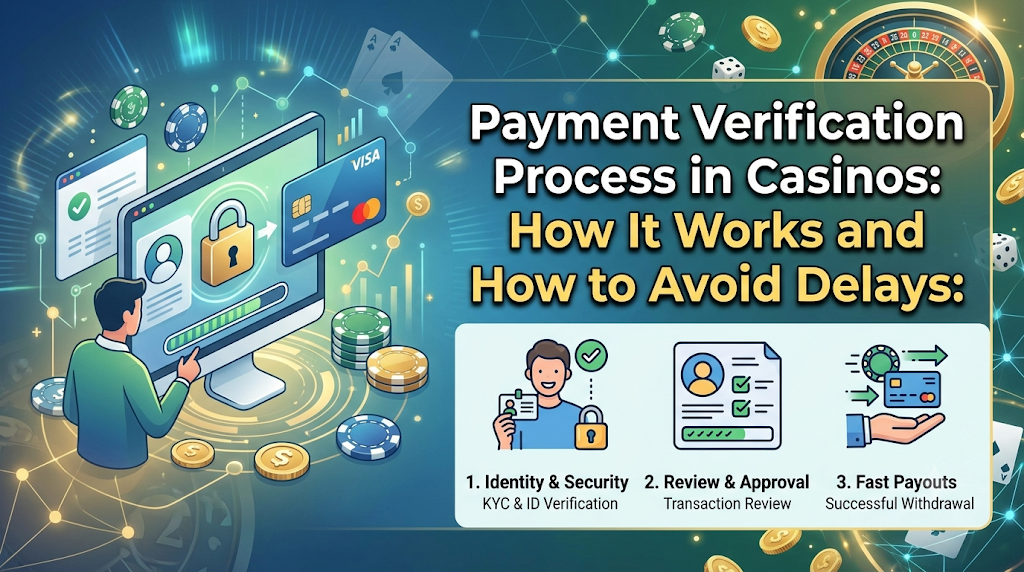
The payment verification process in casinos is a series of identity and financial checks that an operator performs before releasing player withdrawals.
Casinos do not operate like casual video games; they operate under strict financial licenses similar to digital payment providers and banks. Because cash flows in and out of player accounts, licensed sites must follow clear legal mandates:
- KYC (Know Your Customer): A legal requirement where businesses verify the identity and address of their users to prevent identity theft and fraud.
- AML (Anti-Money Laundering): Rules and laws designed to stop criminals from disguising illegally obtained funds as legitimate casino winnings.
When you request a payout, the casino must confirm three core facts:
- Identity: You are a real person of legal gambling age.
- Residence: You physically reside in a jurisdiction where the casino is legally allowed to offer real-money games.
- Financial Ownership: The bank account, credit card, or e-wallet receiving the withdrawal belongs to you and nobody else.
If any of these three links breaks, the payment cannot legally leave the casino’s merchant account.
Why Casinos Enforce Strict Payment Verification
Verification checks can feel tedious to players, but they exist for concrete legal, financial, and safety reasons:
- Regulatory Licensing and Legal Audits: Casinos operate under licenses issued by statutory regulators, such as the Malta Gaming Authority (MGA), the UK Gambling Commission (UKGC), or state gaming boards in North America. These regulators conduct regular audits. If an operator pays out money to unverified accounts, the regulator can impose heavy fines or suspend the casino’s operating license.
- Preventing Money Laundering: Criminals sometimes attempt to deposit dirty money into a gambling site, place minimal bets, and withdraw the remaining balance to make the funds appear as legitimate winnings. To break this cycle, casinos enforce verification alongside a deposit turnover rule, which requires wagering deposited funds at least once before withdrawing.
- Credit Card Fraud and Chargebacks: When someone uses a stolen card to gamble online, the legitimate cardholder disputes the transaction. The bank reverses the payment through a chargeback, leaving the casino with lost funds, processing penalties, and administrative fees. Verifying card ownership protects the platform from stolen financial data.
- Player Account Security: Account takeovers happen across the internet. If an unauthorized person accesses your account, payment verification acts as a secondary gate. Because payouts are restricted to verified accounts under your name, an intruder cannot redirect your balance to their personal account.
- Age Verification and Self-Exclusion: Operators must block minors from gambling. Verification also enforces self-exclusion registries, ensuring players who chose to exclude themselves cannot reopen accounts under alternate details.
The Step-by-Step Payment Verification Workflow
While every casino runs its own risk operations, most licensed platforms follow a standardized four-stage verification sequence:
Stage 1: Proof of Identity (POI)
The casino must confirm your legal name, photograph, and date of birth.
- Acceptable documents: A valid passport, driver’s license, or government national ID card.
- What reviewers look for: The document must be unexpired, all four corners of the card or page must be visible, the text must be readable, and the photograph must be sharp.
- Biometric tools: Many modern platforms use biometric selfie checks. You take a photo of your ID and complete a quick facial scan on your camera to ensure the person holding the ID matches the picture on the card.
Stage 2: Proof of Address (POA)
The operator must confirm that you live at the address registered on your casino profile.
- Acceptable documents: A utility bill (water, gas, electricity, landline internet) or a formal bank statement.
- Age requirement: The document must usually be dated within the last 90 days (three months).
- What reviewers look for: The document must clearly show your full legal name, your physical street address, an official issue date, and the official header of the issuing company. Mobile phone bills and advertising mail are almost always rejected.
Stage 3: Proof of Payment Method (POP)
You must prove that the financial instrument used to fund the account belongs to you. The requirements change based on how you pay:
- Debit or Credit Cards: Upload a photo of the card. Cover the middle digits of the card number, leaving only the first 6 and last 4 digits visible. On the back, cover the 3-digit CVV security code completely.
- E-Wallets (PayPal, Skrill, Neteller): Provide a full-screen, uncropped screenshot of your profile page displaying your registered name, account email, and a visible transaction showing your deposit to the casino.
- Direct Bank Transfers: Provide a recent bank statement or online banking PDF showing your full name, account number or IBAN, and the bank’s header.
- Cryptocurrencies: Licensed crypto operators use automated blockchain analysis tools. If your wallet address connects to sanctioned mixers, darknet markets, or flagged hacks, manual identity verification is triggered immediately.
Stage 4: Risk and Compliance Screening
Behind the scenes, the compliance team screens your profile through specialized databases:
- Politically Exposed Persons (PEP) Lists: Checks whether you or an immediate family member hold a prominent public office, which carries elevated corruption risks.
- Sanction Lists: Cross-checks international watchlists to ensure the player is not legally barred from financial transactions.
- Duplicate Account Checks: Cross-references your IP address, device fingerprint, and physical address against existing accounts to prevent multi-accounting and bonus abuse.
Verification Document Requirements at a Glance
| Document Category | Primary Purpose | Accepted Documents | Strict Requirements | Why Submissions Get Rejected |
| Proof of Identity (POI) | Confirms name, age, and legal existence. | Passport, Driver’s License, National Identity Card. | Must be unexpired; all 4 corners visible; clear photo. | Expired dates, blurred text, flash reflection over text, cropped borders. |
| Proof of Address (POA) | Confirms legal country and state of residence. | Electricity/gas bill, council tax, formal bank statement. | Issued within the last 90 days; full address visible. | Mobile phone bills, junk mail, documents older than 3 months, missing headers. |
| Proof of Payment (POP) | Confirms you own the funding method. | Card photos, e-wallet account screenshot, bank statement. | First 6 and last 4 card numbers visible; CVV masked; name visible. | Leaving the 3-digit CVV exposed, third-party payment methods, cropped screenshots. |
| Source of Wealth (SOW) | Confirms gambling funds match legitimate income. | Paystubs, tax returns, sale of property contract, inheritance papers. | Recent, verifiable documentation matching high deposit volumes. | Incomplete tax forms, payslips not matching player name, failure to explain large deposits. |
When Does Verification Happen?
Understanding the timing of verification helps you avoid surprises when you want your money:
- Verification on Registration (Upfront KYC): In strictly regulated markets like the United Kingdom, casinos cannot legally permit gameplay or deposits before verifying age and identity. Many platforms check third-party databases automatically upon sign-up; if automated matching fails, manual upload is required immediately.
- Verification on First Withdrawal: In jurisdictions like Malta, Curacao, and Gibraltar, players can often register and deposit immediately. However, the first withdrawal request automatically triggers identity and payment document requirements.
- Threshold-Based Verification: Cumulative financial activity triggers mandatory verification under European and international rules, often around €2,000 in total deposits or withdrawals.
- Behavioral Triggers: Sudden changes in betting patterns, frequent changes between different payment methods, or requests for unusually large payouts prompt immediate compliance checks.
Advanced Compliance: Source of Wealth (SOW) Checks
Most recreational players only encounter basic identity, address, and card checks. However, players who deposit or win larger amounts will eventually encounter a Source of Wealth (SOW) or Source of Funds (SOF) check.
A Source of Wealth check investigates where your overall gambling money originated. The casino must confirm that you have sufficient legitimate income to support your betting volume and that the funds are not the proceeds of financial crime.
Regulators hold operators accountable for preventing excessive, unaffordable gambling and financial crime. Acceptable documents include:
- Recent wage slips from your employer (typically the last 3 months).
- Official tax returns or audited company accounts for self-employed individuals.
- Legal documentation of an inheritance, investment dividends, or real estate sales.
- A bank statement proving a divorce settlement or legal payout.
While SOW requests feel personal, they are standard international compliance requirements. Refusing to supply this information will lead to account closure, with remaining balances handled according to regulatory rules.
Automated Verification vs. Manual Human Review
Online casinos handle thousands of players every day and rely on a combination of automated software and human security teams:
- Automated Verification: Platforms use identity software like Jumio, Onfido, or Veriff to analyze documents within minutes. These tools read passport machine-readable zones, inspect holographic security patterns, and match facial geometry from selfies. If an image is clean, approval is almost instantaneous. However, slight glare or blurred text can force the file into a manual queue.
- Manual Human Review: When automated scans fail, or when withdrawals exceed standard limits, human compliance agents review the documents. Analysts examine unusual utility providers, marriage certificates for name changes, and edge-case banking records. While manual reviews handle complex cases accurately, they take longer—usually between 24 and 72 hours.
5 Costly Verification Mistakes Players Make
Most withdrawal delays come down to simple, avoidable user errors:
- Using a Third-Party Payment Method: Depositing money using a spouse’s debit card, a family member’s PayPal account, or a friend’s card is the fastest way to get an account locked. Gambling regulations strictly forbid third-party funding, even with written permission. Always use financial accounts registered in your own legal name.
- Cropping Document Corners: Submitting tight photos of an ID card where the outer edges are cut off raises fraud alerts. Compliance systems inspect border proportions to detect altered images. Place documents on a flat, dark surface and ensure all four corners are visible.
- Exposing Full Card Numbers and CVV Codes: Submitting unedited card photos violates data protection standards. Payment industry rules prohibit casinos from storing your 3-digit CVV number. If you leave it visible, the casino must reject the file for security reasons. Always cover digits 7 through 12 on the front and mask the 3-digit CVV on the back.
- Logging in Behind a VPN During Verification: Uploading identity documents while connected to a Virtual Private Network creates a mismatch between your home address and your browsing location. This triggers automated fraud alerts. Always disable VPNs before uploading documents.
- Using Nicknames During Registration: Signing up with a nickname (such as “Mike” instead of “Michael”) prevents automated verification systems from finding a match. Always enter your full legal name exactly as printed on your government documents.
Step-by-Step Verification Checklist
Follow this checklist before requesting your first withdrawal:
- Name Match: Check that your casino account profile matches your government ID word for word.
- ID Validity: Check that your passport or driver’s license has not passed its expiration date.
- Framing: Place documents on a flat, contrasting surface; confirm all four outer edges and corners are visible in the photo.
- Lighting: Take photos in indirect daylight; make sure there is no camera flash glare washing out text or barcodes.
- Address Recency: Confirm your utility bill or bank statement was issued within the last 90 days.
- Address Type: Make sure the document is a utility bill or bank statement, not a mobile phone bill or junk delivery flyer.
- Card Masking: Cover digits 7 through 12 on the front of your card; cover the 3-digit CVV on the back.
- File Format: Save files as clean, high-resolution JPG, PNG, or original PDF formats.
- Network Check: Disable all VPNs, proxies, and browser location spoofers.
Key Terms Explained
- KYC (Know Your Customer): The mandatory identity verification process businesses use to confirm a customer’s identity and reduce fraud.
- AML (Anti-Money Laundering): International laws and internal controls designed to prevent financial platforms from being used to disguise illegal funds.
- Proof of Identity (POI): An official government document (passport, national ID, driver’s license) that proves a person’s legal name, photo, and age.
- Proof of Address (POA): A recent formal document (utility bill, bank statement) proving a player’s physical residence.
- Proof of Payment (POP): Evidence that a player owns the financial account, card, or e-wallet used to make deposits and withdrawals.
- Source of Wealth (SOW): Detailed financial proof (payslips, tax forms, sale contracts) demonstrating that a high-depositing player’s funds come from legitimate sources.
- Chargeback: The forced reversal of a credit card transaction initiated by the cardholder’s bank, often due to fraud or dispute.
- Deposit Turnover: A rule requiring players to bet their deposited money at least once before cashing out, preventing casinos from being used as unlicensed money transmission channels.
- Biometric Screening: Automated software that compares a live user selfie to an uploaded photo ID to prevent identity theft.
- PEP (Politically Exposed Person): An individual with a high-profile public position whose financial accounts are subject to extra scrutiny due to public corruption risks.
Frequently Asked Questions
How long does casino payment verification usually take?
Automated verification tools can approve clean documents in 5 to 15 minutes. If your documents require manual review by a human compliance agent, the process typically takes between 24 and 72 business hours. Submissions sent over weekends or public holidays often take longer.
Why does a casino let me deposit instantly but delay my withdrawal for verification?
Deposit processing is handled automatically by payment gateways that assume the cardholder is legitimate. However, gambling licenses require full identity verification before money leaves the casino. Operators prioritize quick onboarding for deposits, while withdrawals trigger legal AML obligations.
Is it safe to send photos of my ID and bank cards to an online casino?
Licensed, reputable casinos use encrypted connections (SSL/TLS) and secure document storage protocols compliant with international data protection laws. To protect your banking details, always cover the middle numbers of your payment card and black out the 3-digit CVV code on the back.
Can I withdraw my winnings using someone else’s bank account or card?
No. Regulated casinos strictly forbid third-party withdrawals. The name on the receiving bank account, card, or e-wallet must match the verified name on the casino profile. Attempting to withdraw to someone else’s account can lead to account suspension and canceled winnings.
What should I do if my utility bill is in my landlord’s name?
If you rent and utilities are included in the lease, submit an official bank statement showing your name and current address instead. Alternatively, you can use a government tax statement, council tax letter, or an official tenancy agreement, provided the casino’s support team approves the document type first.
Can I use a mobile phone bill as proof of address?
Almost all licensed casinos reject mobile phone bills. Mobile contracts are easy to obtain with minimal checks and do not reliably prove physical permanent residence. Stick to traditional utility bills (water, gas, electricity, landline internet) or formal bank statements.
Why was my verification rejected even though my documents are real?
The most common reasons are poor image quality (blurry text or glare), cropped document corners, documents older than 90 days, or a small spelling difference between your casino profile name and your legal ID. Review the casino’s rejection notice, fix the issue, and re-upload clear photos.
Can I complete the verification process before I request a withdrawal?
Yes, and doing so is good practice. Many casinos provide a document upload section inside your account settings under “Verification” or “Documents.” Uploading your ID and proof of address right after registering ensures your payouts can be processed immediately when you decide to cash out.
Summary
The payment verification process in casinos can feel like an inconvenience, but it is an essential part of licensed online gaming. These checks keep criminal activity off the platform, protect your funds from unauthorized access, and ensure the casino follows international laws.
You do not need to let verification slow down your payouts. Avoid third-party payment methods, keep your account details consistent with your legal name, and upload clear, uncropped photos of your documents with sensitive digits safely masked. Completing these checks early lets you focus on playing, knowing your withdrawals will process without friction when you are ready to cash out.
