Introduction
Walk into any casino and it looks like pure entertainment — lights, sounds, people enjoying themselves. Behind that experience, though, is a constant stream of data collection and pattern-watching that most players never notice. Every chip placed on a table, every card swiped at a loyalty kiosk, every deposit made on an online betting account feeds into a system built to answer one question: is this behavior normal, or is it a warning sign?
Most articles on this topic either oversimplify it (“casinos watch cameras”) or drown it in compliance jargon that means nothing to a regular reader. This one does neither. You’ll learn what “risky behavior” actually means to a casino, the real tools used to detect it — from an old-school pit boss’s instincts to modern AI-driven behavioral analytics — the difference between fraud detection and player-protection detection, and where these systems genuinely fall short. If you’ve ever wondered what’s actually happening behind the friendly interface of a casino floor or a betting app, this breaks it down.
What Counts as “Risky” Behavior?
Casinos actually track two very different kinds of risk, and it helps to separate them clearly.
Player-protection risk is about a person’s own wellbeing — signs that someone might be developing a gambling problem. This includes chasing losses (betting bigger to win back money already lost), gambling for unusually long stretches without breaks, rapidly increasing deposit amounts, or showing visible distress at a table.
Fraud and compliance risk is about protecting the casino and the financial system — signs of cheating, collusion between players, bonus abuse, or money being moved through gambling to disguise its origin (money laundering).
Both categories get watched using overlapping tools, but the goal behind each alert is different: one aims to help a person, the other aims to stop a crime or a scam. A well-run casino needs to do both without treating every player like a suspect.
How the Detection Actually Works
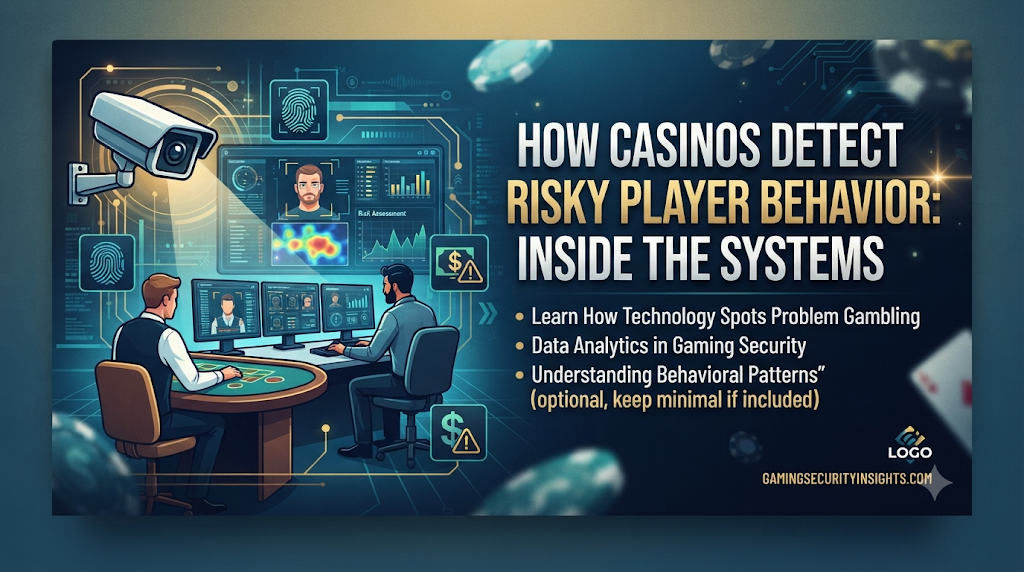
On the casino floor, detection starts with people and cameras. Pit bosses and floor supervisors are trained to notice behavioral cues — a player who suddenly increases bet size after a losing streak, someone who seems agitated or is drinking heavily while playing, or unusual coordination between two players at the same table. Overhead surveillance cameras (often called the “eye in the sky”) record table activity, and loyalty or rewards cards link a player’s identity to their betting history across visits, letting the casino build a long-term profile of normal behavior for that person.
Online, the process is more automated. Betting platforms collect data on every session: how much time a player spends, how often they deposit, how bet sizes change during a session, what time of day they play, and even small technical details like the device and location used to log in. Software builds a baseline of “normal” behavior for each player, then flags anything that deviates sharply from it — for instance, someone who typically deposits small amounts suddenly making several large, rapid deposits in one night.
In both settings, the underlying logic is the same: a single unusual action rarely triggers an alert, but a pattern of unusual actions does.
Why This Matters — For Players and Operators
For players, this system exists, at least in part, to catch problem gambling before it spirals. Regulated casinos are increasingly required to intervene early — a message checking in, a suggested deposit limit, or even a temporary account pause — rather than waiting until someone has lost far more than they can afford.
For operators, detection systems protect the business itself. Undetected fraud, collusion, or money laundering can lead to massive regulatory fines, loss of a gambling license, and reputational damage that’s hard to recover from. Regulators in most licensed markets now expect casinos to show an “audit trail” proving they took action when a risk signal appeared — not just that they had a system in place.
This is also why casinos can’t just ignore risky-looking behavior even when it’s profitable for them in the short term. A player who’s losing heavily might be great for that night’s revenue, but if regulators later find the casino ignored clear warning signs, the operator faces serious consequences.
The Tools Behind the Detection
Behavioral analytics software. This is the backbone of modern online risk detection. It doesn’t just track one number — it looks at combinations: deposit frequency plus session length plus time of day plus bet-size volatility. When several of these shift together, the system’s confidence that something is wrong goes up sharply.
KYC (Know Your Customer) checks. Before a player can withdraw significant winnings, licensed operators verify identity documents, proof of address, and sometimes source-of-funds information. This isn’t just bureaucracy — it’s the first line of defense against fraud and money laundering, and it also confirms the player is old enough and legally allowed to gamble.
AML (Anti-Money Laundering) monitoring. This tracks the money side of things — unusual deposit-and-withdraw patterns (like depositing a large sum, placing minimal bets, then withdrawing almost the full amount) that suggest someone is using the casino to “clean” money rather than actually gamble.
Device and location fingerprinting. This identifies the specific device, browser, and rough location used to access an account. It’s mainly used to catch fraud — for example, someone trying to create multiple accounts to exploit a welcome bonus repeatedly, or a self-excluded player trying to sign back in under a new name.
Loyalty program data (land-based). Every swipe of a rewards card builds a historical profile: typical visit frequency, typical bet size, typical length of stay. A sudden, sharp break from that pattern is often the earliest signal available to a physical casino.
Human observation. Even with all this technology, trained floor staff remain important, especially for reading physical and emotional cues that no dataset captures well — visible frustration, drinking heavily while playing, or asking to borrow money from other patrons.
Real-World Example: How a Pattern Gets Flagged
Imagine an online player who has, for six months, deposited around ₹2,000 a week and played for about 30 minutes at a time. One week, they deposit ₹2,000 four times in a single day, extend sessions to over three hours, and start increasing bet sizes sharply after losses. No single one of these actions is against any rule. But together, they form exactly the pattern behavioral analytics systems are built to catch — a possible sign of chasing losses. A well-designed system would flag this account for review, which might lead to a check-in message, a suggested cooling-off period, or a temporary limit on deposits, depending on the operator’s responsible gambling policy.
Compare that to a different pattern: a player who deposits a large lump sum, places a handful of low-risk bets designed to lose very little, then withdraws almost the entire amount. This looks less like a gambling problem and more like an attempt to move money through the platform — the kind of pattern AML systems are specifically trained to catch.
Same category of tool (pattern detection), two very different reasons for the alert.
Common Mistakes People Assume About Casino Detection
Assuming casinos want to catch problem gamblers early because they’re generous. In reality, regulation is the bigger driver. Licensed operators face real financial and legal penalties for failing to intervene, so player-protection tools exist partly out of genuine care and partly because the law requires it. Understanding this helps set realistic expectations about how proactive a casino will actually be.
Believing one flagged session means an account gets banned immediately. Most systems are built around graduated responses — a check-in message first, then deposit limits, then a longer pause — not instant bans. Full account closures are usually reserved for confirmed fraud or serious, repeated risk indicators.
Thinking online detection is purely automated with no human review. In practice, most flagged accounts are reviewed by a compliance analyst before any action is taken, because automated systems produce false positives — for example, a player who simply got a bonus at work and is celebrating with bigger bets isn’t necessarily in trouble.
Assuming land-based casinos rely mostly on cameras. Cameras matter, but loyalty-card data and trained staff observation are often more important for spotting long-term behavioral change, since cameras only capture what’s happening in the moment.
Where These Systems Genuinely Fall Short
False positives and false negatives. A system tuned too aggressively flags too many normal players, overwhelming compliance teams and eroding trust. A system tuned too loosely misses real warning signs. Getting this balance right is one of the hardest ongoing challenges for any operator.
Cross-platform blind spots. A player showing risky behavior on one platform may simply move to another operator that hasn’t flagged them yet, since most player data isn’t shared across companies except in specific regulated markets with centralized self-exclusion registries.
Cultural and language gaps in behavioral cues. Systems trained mostly on one demographic’s typical patterns can misread normal behavior from a different group as suspicious, or the reverse — miss real warning signs because they don’t match the expected pattern.
Reliance on self-reported information. KYC and AML checks depend heavily on documents and information a player provides. Determined bad actors with forged documents can sometimes get past initial checks, which is why ongoing behavioral monitoring — not just a one-time identity check — matters so much.
A Simple Framework for Understanding Any Detection System
- What data is being collected — deposits, session length, bet sizing, device/location, identity documents.
- What baseline is it compared against — the player’s own history, or a broader population average.
- What triggers a flag — a single extreme action, or a combination of smaller unusual signals.
- Who reviews the flag — fully automated action, or a human compliance analyst.
- What response follows — a message, a limit, a temporary pause, or account closure.
- How is the outcome tracked — does the operator record what happened after intervention, to improve the system over time?
Any serious casino risk-detection program should be able to answer all six of these clearly.
Comparison: Land-Based vs Online Detection
| Factor | Land-Based Casino | Online Casino/Betting Platform |
|---|---|---|
| Main data source | Loyalty card history, staff observation, cameras | Deposit, session, and betting pattern data |
| Speed of detection | Can be slower, depends on staff noticing patterns | Often near real-time, automated |
| Human involvement | High — staff read behavior directly | Lower initially, added for reviewing flagged cases |
| Main risk focus | Cheating, collusion, visible distress | Chasing losses, bonus abuse, money laundering patterns |
| Biggest limitation | Only captures behavior during a visit | Can miss context that a human would notice in person |
Checklist: Signs a Detection System Is Actually Working Well
- Does it use a combination of signals rather than a single trigger?
- Does it compare a player to their own history, not just an average player?
- Are flagged accounts reviewed by a human before serious action is taken?
- Is there a clear, graduated response (message, then limit, then pause) rather than an instant ban?
- Does the operator track what happened after an intervention, to improve accuracy over time?
- Are self-exclusion and deposit-limit tools genuinely easy for a player to access themselves?
Key Terms to Know
- KYC (Know Your Customer): The identity verification process casinos use to confirm who a player really is.
- AML (Anti-Money Laundering): Rules and systems designed to stop criminals from disguising illegal money as gambling winnings.
- Behavioral analytics: Software that studies patterns in a player’s activity to spot unusual or risky changes.
- Chasing losses: Increasing bets after a loss in an attempt to win back money already lost — a key warning sign of problem gambling.
- Self-exclusion: A program letting players voluntarily ban themselves from gambling platforms for a set period or permanently.
- Device fingerprinting: A technique that identifies a specific device or browser, used to catch players creating multiple accounts.
- False positive: When a detection system flags normal behavior as risky by mistake.
- Source of funds (SOF): Documentation proving where a player’s money legitimately came from, often required for large transactions.
- Audit trail: A recorded history of what a casino noticed and what action it took, used to prove compliance to regulators.
Frequently Asked Questions
Do all casinos use the same risk-detection methods?
No. Land-based and online casinos use different tools suited to their setting, and the sophistication varies a lot between small operators and large, heavily regulated companies.
Can a casino ban someone just for winning a lot?
Winning alone isn’t usually treated as risky behavior, though a sudden, unusual pattern combined with large wins might prompt identity or fund-source checks, especially for anti-money-laundering reasons.
Is behavioral detection only about stopping problem gambling?
No — it also plays a major role in catching fraud, bonus abuse, and money laundering. Player protection and financial-crime prevention often use overlapping tools but serve separate goals.
How quickly can an online platform detect risky behavior?
Well-built systems can flag unusual patterns within minutes, though a human compliance reviewer often checks the flag before any account action is taken.
Do self-exclusion programs actually stop someone from gambling elsewhere?
Self-exclusion works reliably within the platform or, in some regulated markets, across a shared national registry — but it generally doesn’t prevent someone from signing up on an entirely different platform that isn’t part of that system.
What happens after a player is flagged for risky behavior?
Responses usually follow a graduated approach: a check-in message first, then options like deposit limits or a cooling-off period, and account restrictions only in more serious or repeated cases.
Can detection systems make mistakes?
Yes. Systems can misread normal behavior as risky (a false positive) or miss genuine warning signs (a false negative), which is why human review remains part of most serious detection processes.
Why do casinos need identity verification if someone is just playing for fun?
KYC checks aren’t only about catching fraud — they also confirm legal age, prevent underage gambling, and are often a licensing requirement regardless of how a player intends to use the account.
Conclusion
Detecting risky player behavior isn’t a single tool — it’s a layered system combining data (deposits, session patterns, bet sizing), technology (behavioral analytics, device tracking), identity and financial checks (KYC and AML), and human judgment (floor staff and compliance reviewers). The two goals behind it — protecting players from harm and protecting the business from fraud — often use the same signals but lead to very different next steps.
The most important thing to take from this isn’t a list of tools, but the underlying logic: no single action tells the full story, but a pattern almost always does. That’s true whether you’re looking at a casino floor, an online betting platform, or honestly, most systems built to catch unusual human behavior.
