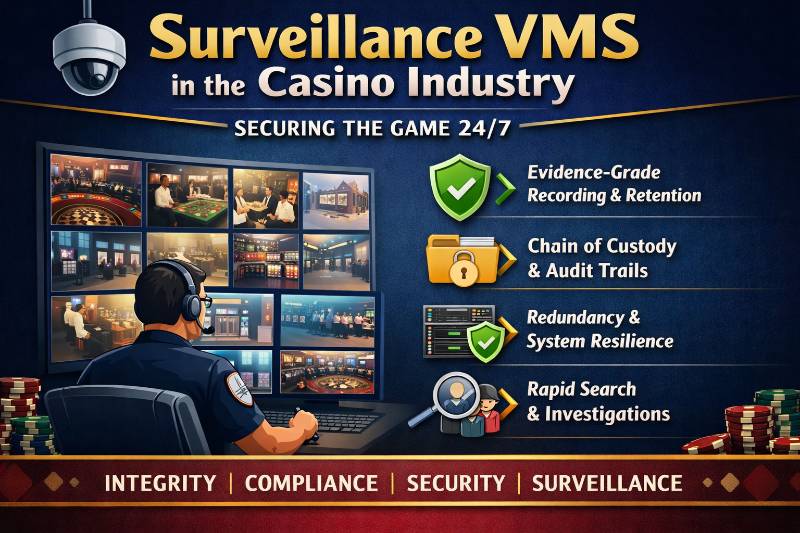
Casino surveillance isn’t “just CCTV.” It’s a regulated, evidence-grade, 24×7 operation that sits at the center of game integrity, dispute resolution, fraud prevention, and guest safety. A modern Surveillance VMS (Video Management System) is the software-and-systems layer that collects, records, indexes, secures, and retrieves video from hundreds—or thousands—of cameras across gaming floors, cages, count rooms, table pits, entrances, back-of-house corridors, and high-risk operational zones.
In most industries, video is “nice to have.” In casinos, video is often a primary control—the system of record that validates table disputes, confirms fills/credits, supports investigations, and proves compliance. That’s why casino-grade VMS design prioritizes chain-of-custody evidence, auditability, redundancy, and strict access controls, not just camera count.
Why casinos are different: what a VMS must do on a gaming floor
Casinos combine high cash velocity, dense crowds, and fast-moving transactions. A surveillance system must handle:
- High camera density and continuous recording (many areas cannot tolerate gaps).
- Evidence quality requirements (clarity, frame rate, time/date overlays) and retention expectations set by regulators. For example, one regulator’s land-based casino manual requires 30 images per second, minimum clarity standards, minimum 14-day retention, failure notifications, and redundancy so a single component failure doesn’t lose data.
- Security controls around remote access (encrypted, firewalled, password protected, and disclosed to the regulator in that same manual).
- Watermarking/verification codes to protect integrity of recorded video (explicitly required in that manual).
- Operational logging (malfunctions/repairs logs and daily/visitor logs in the surveillance room are mandated in that manual).
- Anti-tampering expectations (explicit “no tampering” provisions exist in that manual).
In short: casino VMS is built to be operationally resilient and legally defensible.
Core features of a casino-grade Surveillance VMS
1) High-integrity recording and retention
A casino VMS must record continuously, manage retention policies, and ensure video is not silently lost.
Key capabilities commonly expected in casino environments include:
- Defined minimum retention (often weeks, sometimes longer for specific incidents like detentions). One regulator manual specifies 14 days minimum, and 30 days for detentions/questioning recordings.
- Failure notification (audible/visual alerting when surveillance or storage fails).
- Redundant storage design so a single component failure does not cause data loss.
- Secure placement of recording infrastructure (recording equipment in a secure room).
2) Evidence management and chain of custody
Casinos regularly export video to internal investigators, compliance teams, and law enforcement. That export must be provably authentic.
Look for:
- Watermarking / video verification codes on recorded media (explicitly required in at least one casino regulatory manual).
- Hashing / integrity checks to prove the clip wasn’t modified after export—some vendors document evidence handling that includes hashing for integrity verification. ()
- Controlled export workflows (who exported, why, what time range, what camera, and where it was stored).
- Evidence packaging (player-friendly playback is not the goal—court-ready authenticity is).
3) Audit trails and accountability
When money and licensing are involved, you must assume every meaningful action will need to be explained later.
A strong VMS should provide:
- Audit trails for configuration and security changes (who changed what, when). Genetec’s documentation, for example, explicitly describes logged configuration changes and audit trail reporting. ()
- Role-based permissions to separate duties (surveillance operator vs. admin vs. IT).
- Session logging (logins/logouts, failed access attempts, playback access to sensitive cameras).
4) Secure and compliant remote access
Modern casinos often need remote viewing for executives, compliance, or multi-property operations—but remote access is also a major risk.
A regulator manual example requires remote access to be disclosed and specifies encrypted transmission, firewalling, and password protection.
In practice, “casino-grade” remote access usually means:
- MFA + least privilege (no shared accounts)
- Network segmentation (surveillance network isolated from general corporate networks)
- Jump-host / bastion patterns with full monitoring (especially for vendor support)
- Tamper-resistant logging (so remote actions are reviewable)
5) Dedicated surveillance network and resilient streaming
Casinos treat surveillance like a critical utility: it needs its own hardened transport.
A regulator manual example calls for a dedicated surveillance data network with redundancy and fault-tolerant design.
In practical terms, you want:
- Dedicated switching and fiber uplinks for surveillance traffic
- Bandwidth planning (codec choice, resolution, frame rate, motion vs continuous)
- Edge recording options (camera SD failover for short outages)
- Time synchronization (consistent timestamps across cameras and systems)
6) Scalable architecture for thousands of cameras
Casinos scale fast: expansions, new pits, new entrances, new venues, new compliance demands.
VMS platforms like Milestone document architectures designed to scale across multi-site deployments using multiple components and server roles. ()
For casino use, scalability means:
- Multi-server recording services
- Failover recording
- Centralized viewing across properties (while maintaining local autonomy)
7) Advanced search and analytics (used carefully)
Casinos benefit from analytics that reduce search time and help operators respond quickly:
- Motion and object search to find incidents faster
- People counting and queue monitoring for operational insights
- Table-game support (PTZ presets, patrol tours, quick recall of camera groups)
Some casino-oriented security vendors emphasize multi-sensor coverage and analytics to enhance situational awareness on gaming floors. ()
That said, advanced analytics can introduce privacy, bias, and regulatory concerns—so casinos often deploy it with clear policy controls and strict governance.
The real-world pros and cons of casino surveillance VMS
Pros
1) Dispute resolution becomes fast and defensible
When a payout is questioned or a patron disputes an event, VMS reduces “he said / she said” into evidence.
2) Strong deterrence and faster investigations
Visible, reliable surveillance discourages internal theft, collusion, and opportunistic crime—and helps confirm facts quickly.
3) Regulatory readiness
Retention, audit trails, anti-tamper controls, and secure export are not just good practice; they’re often requirements.
4) Operational performance improves
Better incident workflows, fewer blind spots, and better coverage planning reduce downtime and risk exposure.
5) Multi-property standardization
An enterprise VMS lets you unify procedures, training, and evidence handling across multiple venues.
Cons
1) Storage and bandwidth costs grow relentlessly
Higher resolution, higher FPS, and longer retention explode storage needs. Casinos must plan 3–5 years ahead.
2) Complexity and “fragile integrations”
VMS rarely lives alone: cameras, access control, alarms, POS overlays, and identity systems can create brittle dependencies if not designed cleanly.
3) Cybersecurity becomes a first-class problem
VMS touches critical networks and sensitive footage. Poor segmentation or weak credential practices can become a major incident.
4) Privacy and governance risks
More cameras + more analytics = higher privacy stakes. Casinos need strict access policies, retention discipline, and documented use cases.
5) Upgrade windows can be constrained
Casinos can’t casually change systems that are tied to compliance. Some environments require formal change control, validation, or approval processes.
“Best VMS software in the world” for casinos: what actually wins in practice
There isn’t one universal “best” VMS for every casino. The best platform depends on your priorities:
- Enterprise-scale resilience and unified security operations
- Open-platform integration with the widest camera/analytics ecosystem
- AI-first search and camera-to-VMS optimization
- Multi-site federation and centralized command
- Compliance-grade auditability and evidence handling
That said, across global enterprise deployments, a few names consistently show up on shortlists and market comparisons. Independent market/company lists commonly include Milestone Systems, Genetec, Bosch, Honeywell, and others among top VMS players. ()
Tier-1 shortlist for casino-grade surveillance
1) Genetec Security Center (often chosen as “best overall” for enterprise casinos)
Why casinos pick it: unified security platform approach, strong audit trails, enterprise roles/components, and multi-site capabilities. Genetec documentation explicitly emphasizes audit trail reporting for configuration changes and provides architecture roles like media routing and archiving—useful in large deployments. ()
Best-fit casino profile: large properties, multi-property groups, environments that want one operational console across video + security workflows, and teams that care deeply about governance and auditability.
2) Milestone XProtect (often chosen as “best open-platform VMS ecosystem”)
Why casinos pick it: open-platform philosophy and broad integration options. Milestone positions XProtect as an open platform that integrates with many cameras and third-party solutions, and public materials cite very broad device support and large-scale deployments. ()
Best-fit casino profile: properties that want maximum flexibility in camera/analytics choices, or that already have a diverse hardware estate and need a VMS that “plays well with others.”
3) Avigilon Unity (often chosen for “camera + analytics + VMS synergy”)
Why casinos pick it: strong emphasis on casino environments, coverage designs for gaming floors, and analytics-driven search capabilities. Avigilon markets dedicated casino security solutions and VMS capabilities. ()
Best-fit casino profile: casinos aiming to reduce investigation time with analytics-assisted search, and properties standardizing on a closely integrated camera + VMS stack.
Best company in the world (for casino VMS): a practical answer
If you force a single choice under “casino-grade, enterprise, compliance-heavy, multi-property” conditions, Genetec is a strong candidate for “best overall company” because it consistently targets enterprise governance, auditability, and multi-site security operations—capabilities that map tightly to casino realities (regulators, evidence, internal controls, and 24×7 uptime). The availability of explicit audit trail reporting and federation/multi-system concepts in their documentation supports that enterprise direction. ()
However, if your top priority is open ecosystem integration and maximizing hardware/analytics choice, Milestone is the “best company” argument—because its open platform stance and broad device/integration footprint are central to its positioning. ()
How to decide (casino-specific):
- Choose Genetec when governance, audit trails, multi-site command, and unified operations are the priority.
- Choose Milestone when openness, integration breadth, and “best-of-breed” mixing is the priority.
- Choose Avigilon when integrated analytics and casino-floor camera coverage designs drive the business case. ()