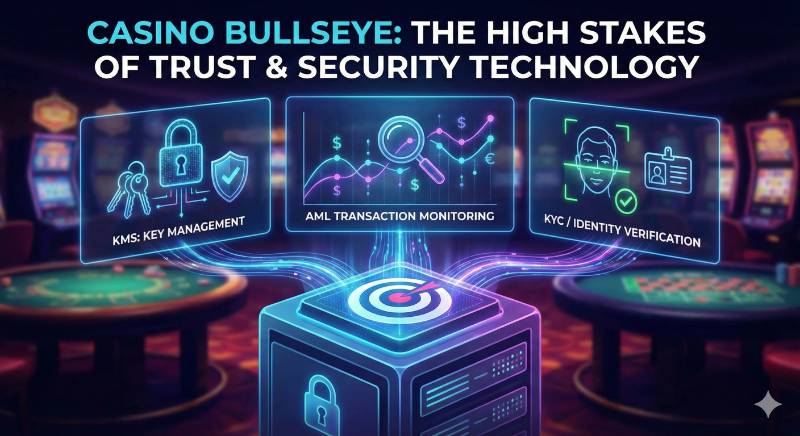
A detailed, practical research blog for resort casinos, iGaming, sportsbooks, and gaming-device ecosystems.
Casinos are unusual compared to “normal” enterprises: they combine high-throughput payments, high-value identities/PII, always-on operations, and a huge distributed device footprint (EGMs/slots, kiosks, POS, cages, surveillance, mobile apps). All of it depends on cryptography. And cryptography depends on keys.
A Key Management System/Service (KMS) is the control plane for keys: how they’re created, stored, used, rotated, revoked, audited, and (most importantly) governed. NIST’s key management guidance emphasizes that poor key-management choices can create an “illusion of security,” and lays out the functions and protections required across the key lifecycle. (NIST Computer Security Resource Center)
This guide focuses on cryptographic KMS (encryption/signing)—not physical key cabinets.
1) What “KMS” means in real casino systems
A KMS typically provides:
- Key lifecycle: generate/import, activate, rotate, disable, destroy
- Key protection: often HSM-backed (hardware security module)
- Key usage APIs: encrypt/decrypt, sign/verify, wrap/unwrap keys
- Policy & access control: least privilege, separation of duties, approvals
- Audit logging: who used which key, when, from where, for what
KMS vs HSM (casino-friendly mental model)
- HSM = the hardened boundary where sensitive key operations occur. Many regulated environments prefer or require HSM-backed protection. FIPS 140-3 defines security requirements for cryptographic modules (which includes many HSMs). (NIST Computer Security Resource Center)
- KMS = the governance and automation layer around keys (often using HSMs underneath).
2) Why casinos need KMS (beyond “security best practice”)
2.1 The casino threat model is brutal
Casinos face:
- Direct monetization attacks (wallet drain, payment fraud, jackpot tampering)
- Identity theft (loyalty + KYC data is highly valuable)
- Distributed endpoint risk (thousands of devices, often long-lived)
- Regulatory scrutiny (gaming labs, regulators, payment compliance)
KMS is how you keep cryptography trustworthy under that pressure.
2.2 Regulators and labs care about integrity controls
Gaming standards (commonly used as baselines by jurisdictions) include requirements around system integrity and security across gaming devices and interactive gaming systems. Examples include GLI-11 (Gaming Devices) and GLI-19 (Interactive Gaming Systems). (Gaming Labs International)
Sports/event wagering systems often reference standards like GLI-33. (Gaming Labs International)
Even when a standard doesn’t say “use KMS,” the controls it implies (integrity, auditability, controlled access, cryptographic protections) effectively push you toward mature key management.
2.3 Payments push you into formal key management practices
The PCI Security Standards Council glossary defines cryptographic key management as the processes and mechanisms that support key establishment and maintenance (including replacing older keys), and defines dual control / split knowledge concepts used in key handling. (PCI Security Standards Council)
In practice, payment environments frequently expect strong controls around key protection, access, and rotation.
3) What casinos use KMS for (encryption + signing use cases)
Below are the highest-value KMS use cases in casino ecosystems.
3.1 Encryption for “money data”
- Cardholder data environments (CDE), token vaults, settlement files, chargeback archives
- Cashless gaming wallets and transaction ledgers
- Cage systems, kiosks, POS integrations
KMS value: keys are centrally controlled, rotated, and audited; key misuse is easier to detect and contain.
3.2 Encryption for “identity data”
- PII in loyalty/CRM (profiles, preferences, travel patterns)
- KYC/AML artifacts (IDs, evidence, risk scoring outputs)
- Insider-risk sensitive tables (high-roller notes, comps history)
KMS value: field-level encryption or application-layer encryption becomes feasible at scale because keys are managed centrally.
3.3 Signing for game integrity and software supply chain
This is the casino-unique driver: signing keys are used to ensure only trusted code/config/content is accepted by systems and devices.
Typical signing targets:
- Firmware/images for EGMs and kiosks
- Game content packages
- Critical config (paytable-related configs, payout rules, etc.)
- Release artifacts in CI/CD (iGaming platforms)
KMS value: signing keys stay protected (often HSM-backed), access is tightly controlled, and signing events are auditable.
3.4 Secure communications (TLS + service identity)
- mTLS between services in iGaming microservice platforms
- Internal APIs between casino management systems, jackpot controllers, kiosks
- Certificates for device identity
KMS value: key and certificate governance is centralized; rotation becomes operationally realistic.
4) Core concepts you must get right
4.1 Symmetric vs asymmetric keys (how casinos use them)
- Symmetric (e.g., AES): bulk encryption for databases, files, logs, video archives
- Asymmetric (e.g., RSA/ECC): signing, certificates, device identity, key exchange
A mature casino program usually has both and treats signing keys as “crown jewels.”
4.2 Key hierarchy: DEK and KEK (envelope encryption)
Most modern designs avoid using a master key to encrypt lots of data directly. Instead they use envelope encryption:
- A Data Encryption Key (DEK) encrypts the actual data.
- A Key Encryption Key (KEK) encrypts (“wraps”) the DEK.
- The KEK lives in KMS (often HSM-backed). The wrapped DEK can be stored with the ciphertext.
Google describes envelope encryption as encrypting a key with another key and notes it as a common multi-layer pattern at scale. (Google Cloud Documentation)
AWS also documents envelope encryption patterns and related tooling. (AWS Documentation)
Casino takeaway: envelope encryption is how you protect massive datasets (surveillance archives, transaction logs, player data lakes) without turning KMS into a throughput bottleneck.
4.3 Separation of keys and data
OWASP recommends keeping keys separate from encrypted data where possible and treating key rotation/compromise as first-class lifecycle events. (cheatsheetseries.owasp.org)
Casino takeaway: don’t store keys in the same database/table/backup set you’re trying to protect.
5) Designing a casino-grade KMS program (architecture patterns)
Pattern A: Cloud-first iGaming / sportsbook
When: your core platform runs on AWS/Azure/GCP.
How: use native cloud KMS for KEKs + envelope encryption in applications and storage.
Pros:
- Tight integration with cloud storage, databases, IAM
- Strong audit trails
- Faster rollout
Risk areas:
- Multi-cloud portability
- Concentration risk if IAM is weak (KMS is only as strong as who can call decrypt/sign)
Pattern B: Hybrid resort casino (most common)
When: on-prem CMS, EGMs, surveillance + cloud analytics.
How: enterprise KMS/HSM on-prem for crown jewels + cloud KMS for cloud workloads, bridged by policy and governance.
Pros:
- Clear separation of regulated/on-prem and elastic cloud workloads
- Keeps signing/payment root keys in tighter control
Risk areas:
- Integration complexity (KMIP/PKCS#11, custom adapters)
- Operational discipline (rotation cadence, access reviews)
Pattern C: “Hold Your Own Key” / External Key Management
When: regulators, internal risk, or policy require keys remain under your control even for cloud workloads.
Cloud vendors support external key management models; for example, Google Cloud highlights visibility/controls around key access decisions in its key management offerings. (Google Cloud)
Pros:
- Stronger separation from cloud operator access
- Better alignment with strict regulatory expectations
Risk areas:
- Availability becomes your problem (if external KMS is down, decrypt/sign may fail)
- You must engineer resilience carefully
6) Governance: the controls casinos should insist on
6.1 Access control that matches casino risk
Minimum bar:
- Strong IAM/RBAC
- Break-glass access with approvals
- Separate roles:
- Key admins (create/rotate policy)
- Key users (services allowed to encrypt/decrypt)
- Auditors (read logs only)
PCI glossary concepts like dual control (dividing knowledge/control among entities) are foundational in environments where manual key operations exist. (PCI Security Standards Council)
Even if you’re fully automated, the principle still matters: avoid “one human can do everything.”
6.2 Audit logs you can actually use
You want to answer:
- What decrypted what?
- Which service identity used the key?
- From which environment (prod vs test)?
- Was the call normal for this service?
6.3 Cryptoperiods (key lifetimes) + rotation strategy
Rotation isn’t “rotate everything monthly and pray.” It’s about:
- Data sensitivity and exposure
- Volume of ciphertext produced
- Blast radius you can tolerate
- Operational cost
PCI glossary defines “cryptoperiod” and points to NIST guidance. (PCI Security Standards Council)
NIST SP 800-57 is the canonical baseline for thinking about key lifetimes and lifecycle management. (NIST Computer Security Resource Center)
Practical rotation patterns:
- KEK rotation: rotate KMS keys; re-wrap DEKs gradually (often supports staged migration)
- DEK rotation: rotate per-object/per-record keys (usually done by re-encrypting data)
- Signing key rotation: requires more ceremony (verifiers must trust new public keys/certs)
7) Implementing KMS in a casino: step-by-step blueprint
Step 1 — Inventory your “crypto assets”
Build a map of:
- Data stores: player DB, wallet ledger, surveillance storage, data lake, backups
- Services: auth, wallet, promo, risk, settlement, CMS integrations
- Devices: kiosks, EGMs, POS endpoints, etc.
- Integrity targets: firmware, content packages, configs
Output: a list of “things that must be encrypted” and “things that must be signed.”
Step 2 — Define a key taxonomy (this prevents chaos)
Example taxonomy:
- Root / platform keys (highest sensitivity; HSM-backed)
- KEKs (wrapping keys in KMS; per-domain or per-tenant)
- DEKs (per-object, per-table, per-file)
- Signing keys (release signing, firmware signing, config signing)
- TLS / identity keys (cert private keys, mTLS)
Step 3 — Choose interfaces: KMIP / PKCS#11 where needed
For integrating enterprise encryption systems and security products, interoperability matters:
- KMIP is a standard protocol for communication between key management clients and servers (keys, certificates, operations). (OASIS Open)
- PKCS#11 (Cryptoki) is a standard API widely used to interact with HSMs and tokens. (OASIS Open)
Casino reality:
- Payments/HSM stacks often speak PKCS#11.
- Storage/database encryption products often speak KMIP.
Step 4 — Use envelope encryption for scale
- KMS protects KEKs (and logs usage)
- Apps/services generate DEKs, encrypt data locally, store wrapped DEKs next to ciphertext
This is the default “scales to surveillance and analytics” pattern. (Google Cloud Documentation)
Step 5 — Engineer resilience (casinos can’t go down)
Design for:
- Multi-zone / multi-site KMS availability
- Clear failure modes:
- Encrypt operations can often continue (depending on design)
- Decrypt operations may become critical-path—plan carefully
- Cache strategy for DEKs (with strict TTLs and memory protections)
Step 6 — Operationalize key ceremonies for crown jewels
For high-impact keys (payments root keys, signing keys):
- Formal creation/rotation procedures
- Strong change management + approvals
- Offline backups only if required, with strict controls
- Regular access reviews
Step 7 — Build incident response “key playbooks”
You need pre-written playbooks for:
- Suspected key compromise
- IAM compromise that could allow decrypt/sign
- Forced rotation events
- Revocation of signing trust (e.g., compromised release key)
8) Casino-specific pitfalls (things that cause real outages or audit pain)
- Using one KMS key for everything
Leads to massive blast radius and messy audit narratives. - Mixing dev/test/prod in one key ring / policy domain
Eventually causes accidental decrypt access and compliance issues. - Treating signing keys like “normal keys”
Signing keys are often higher impact than encryption keys because they can enable trusted malware. - No plan for long-lived devices (EGMs/kiosks)
Device fleets may be offline for maintenance windows; rotation must account for delayed updates. - No way to prove who decrypted what
If you can’t answer this quickly, investigations and regulator conversations get painful.
9) What to include in a “casino KMS requirements checklist” (copy/paste ready)
Security
- HSM-backed protection for root/signing/payment keys (FIPS 140-3 aligned modules where required) (NIST Computer Security Resource Center)
- Per-domain or per-tenant key separation
- Strong IAM/RBAC, least privilege
- Approvals/break-glass for sensitive ops (disable/delete/export)
Lifecycle
- Documented cryptoperiods (by key type) (PCI Security Standards Council)
- Automated rotation where possible
- Proven re-wrapping / re-encryption strategy
Audit
- Immutable logs of encrypt/decrypt/sign operations
- Easy export to SIEM and correlation with service identity
Integration
- Envelope encryption support (Google Cloud Documentation)
- KMIP and/or PKCS#11 where relevant (OASIS Open)
Compliance posture
- Evidence-ready controls for payments, gaming lab reviews, and internal audits (NIST-style lifecycle discipline) (NIST Computer Security Resource Center)
10) Who in a casino organization uses KMS?
- Security / GRC: policy, audits, key ceremonies, access reviews
- Platform engineering / DevSecOps: envelope encryption, service identity, CI/CD signing
- Payments team: tokenization, settlement encryption, HSM workflows
- Gaming systems / device engineering: firmware/content signing and device identity
- Data platform: encryption for lakes/warehouses and backups
- Surveillance IT: encrypted archives and controlled retrieval workflows
