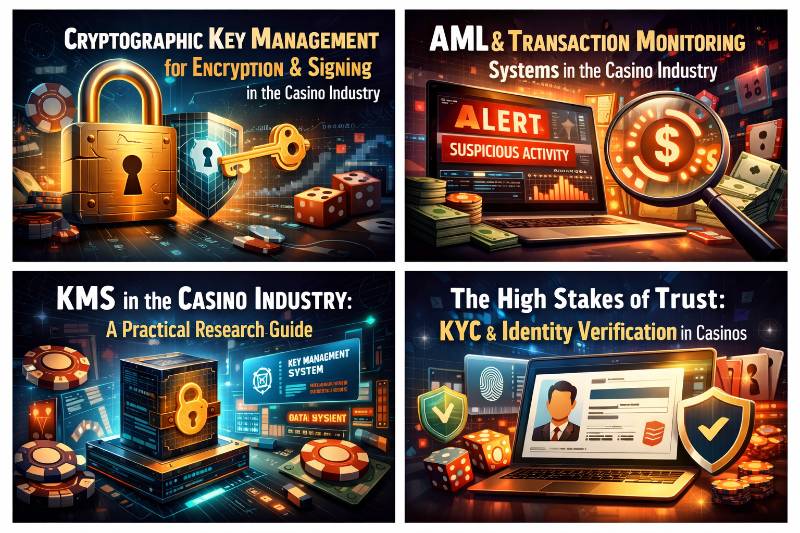
A practical research guide: what they do, why casinos need them, who uses them, how they work, and the leading software vendors (top 20).
Casinos (land-based, online, and sportsbooks) sit in a unique risk zone: high-volume transactions, lots of cash, rapid movement of value, and “convertible” instruments like chips, tickets, and wallets. Global standard-setters have repeatedly highlighted that casinos and gaming are vulnerable to criminal exploitation, and that AML obligations on casinos have been strengthened accordingly. ()
What is AML Transaction Monitoring (in simple terms)?
AML transaction monitoring is the continuous process of watching customer/player financial activity and gameplay-related value movements to detect patterns that may indicate money laundering, fraud, terrorist financing, or other financial crimes—then generating alerts for investigation and (when required) regulatory reporting. A common definition is “monitoring transactions… for suspicious patterns indicative of money laundering or other financial crimes,” and it explicitly applies to institutions including casinos. ()
What is the use of AML Transaction Monitoring in casinos?
An AML Transaction Monitoring System (TMS) helps a casino:
1) Detect suspicious behavior early (before it becomes a regulatory failure)
Examples include:
- Cash-in/cash-out with minimal play (value “washed” through chips/tickets/wallets)
- Structuring transactions to avoid reporting thresholds (e.g., multiple smaller buy-ins)
- Third-party activity (someone funds/plays/withdraws for someone else)
- Chip dumping / collusion (esp. poker) to transfer value between players
- Rapid deposits/withdrawals in iGaming, multi-instrument payments, unusual patterns across devices/accounts
These patterns are commonly discussed as casino/gaming vulnerabilities and typologies by AML-focused guidance and industry best practices. ()
2) Support compliance with AML program requirements
In the U.S., casinos covered by the Bank Secrecy Act operate under 31 CFR Part 1021, including requirements for an AML program and suspicious activity reporting. ()
Other jurisdictions also explicitly scrutinize whether customer and transaction monitoring occurs early enough and in line with a risk-based approach (example: UK Gambling Commission casework trends). ()
Australia has also seen strong enforcement pressure on gambling operators’ AML/CTF programs. ()
3) Improve operational consistency and audit readiness
A good system gives you:
- A complete audit trail (what triggered an alert, who reviewed it, what evidence was used)
- Centralized case management, attachments, notes, approvals
- More consistent decisions (less “analyst-by-analyst” variation)
4) Reduce false positives and investigator workload
Modern platforms blend:
- Rules + thresholds (classic scenario monitoring)
- Behavioral analytics, graph/entity resolution, and ML to reduce noise
This is a major focus of newer AML monitoring approaches. ()
Who is using AML Transaction Monitoring (in the casino ecosystem)?
Primary users
- Land-based casinos & integrated resorts
Cage/cashier, table games, slots, marker/credit, loyalty programs, VIP operations. () - Online casinos / iGaming operators / sportsbooks
Wallet deposits/withdrawals, payment method risk, multi-accounting signals, velocity and device/IP patterns, cross-channel risk. () - Tribal casinos and card rooms (jurisdiction-specific, but generally still subject to strong AML expectations when regulated)
Internal teams who use it daily
- AML/Title 31 compliance teams (BSA/AML officers, MLROs)
- Fraud/risk teams (often combined “FRAML” operations)
- Surveillance and security teams (for high-risk patrons/incidents)
- Internal audit & independent testing teams
External stakeholders who rely on outputs
- Regulators/examiners (e.g., BSA examinations in the U.S.) ()
- Law enforcement (via SAR/STR reporting pipelines)
- Banking/payment partners (for risk governance and due diligence)
What an AML Transaction Monitoring System does (end-to-end workflow)
A casino-grade AML TMS typically covers the full loop:
- Data ingestion
- Cage transactions, slot TITO activity, table game ratings, buy-ins, cash-outs
- Player tracking/loyalty identity, KYC documents
- iGaming wallets, deposits/withdrawals, payment rails, chargebacks
- Watchlists/PEP/sanctions screening signals
- Normalization + “Patron 360”
- Link aliases, multiple accounts, devices, payment instruments
- Consolidate activity across properties or channels
- Detection (rules + analytics)
- Scenarios like structuring, velocity, unusual value transfers, minimal play
- Risk scoring (customer risk + transaction risk + behavior risk)
- Alerting & prioritization
- Queue management, severity scoring, SLA timers
- Case management & investigation
- Evidence capture, narrative building, approvals, audit trail
- Regulatory reporting & recordkeeping
- SAR/STR preparation, CTR-like reporting where applicable, retention
Industry best practices for casinos explicitly frame monitoring + investigation + reporting as core components of a mature program. ()
Casino-specific monitoring: patterns you must cover
Below are high-impact scenarios casinos commonly implement (tailor thresholds to your jurisdiction and risk appetite):
Cash-intensive & threshold behavior
- Multiple transactions just below reporting thresholds (same day / multiple days)
- Split buy-ins across cages, shifts, or properties (“structuring” behavior)
- Use of third parties to execute parts of a transaction chain
Chip/ticket/value conversion
- Buy chips → minimal play → redeem for cash/cashier’s check/wire
- Slot tickets used as value movement tools (rapid in/out)
- Repeated large buy-ins with low theoretical loss relative to play
Gameplay-enabled value transfer
- Poker chip dumping / collusion patterns
- Unusual transfers between known associates (when identity linkage exists)
VIP / higher-risk corridors
- High-frequency high-value activity, junket-like dynamics, cross-border funding signals
- Source-of-funds/source-of-wealth triggers where required
Global and industry guidance emphasizes that casinos are cash-intensive and vulnerable, and that gaps in monitoring and controls are recurring issues. ()
Implementation blueprint (what “good” looks like)
Phase 1 — Foundation (0–90 days conceptually)
- Risk assessment by product/channel (tables, slots, cage, iGaming, sportsbook)
- Data mapping: define “system of record” and identifiers
- Start with a minimum viable scenario set (structuring, cash-in/out, velocity, third-party)
Phase 2 — Tuning & operationalization
- Back-test scenarios on historical data (false positives vs true positives)
- Build investigation playbooks and QA checks
- Define governance: model/rule change control, approvals, audit logging
Phase 3 — Mature monitoring
- Entity resolution + graph linkage
- Behavioral analytics augmentation
- Cross-channel fusion (retail + online + payments + device intelligence)
Regulators explicitly look for monitoring that is timely and risk-based—late detection is a common failure mode. ()
Top 20 leading companies in AML Transaction Monitoring software (usable in casinos)
This list mixes enterprise AML leaders and casino/gaming-focused platforms. (Many casinos use general financial crime platforms; gaming specialists tend to win on Title 31 / gaming workflows and integrations.)
Enterprise / cross-industry leaders
- NICE Actimize (Suspicious Activity Monitoring / AML) ()
- SAS (SAS Anti-Money Laundering) ()
- Oracle Financial Services (FCCM / AML monitoring) ()
- SymphonyAI (NetReveal) (AML transaction monitoring suite lineage) ()
- Nasdaq Verafin (financial crime management / AML monitoring) ()
- FICO (TONBELLER / Siron) ()
- LexisNexis Risk Solutions (recognized for AML transaction monitoring positioning) ()
- Temenos (Financial Crime Mitigation suite) ()
- Eastnets (SafeWatch AML monitoring) ()
- ACI Worldwide (AML framework support and monitoring positioning) ()
- IMTF (Siron One) (positioned in AML transaction monitoring market leadership messaging) ()
AI-native / modern monitoring platforms (strong in analytics + efficiency)
- Feedzai (AML + financial crime analytics positioning) ()
- Featurespace (AML transaction monitoring solution messaging) ()
- ComplyAdvantage (AI-driven transaction monitoring) ()
- Napier AI (transaction monitoring product) ()
- Quantexa (transaction monitoring approach & AML context) ()
- ThetaRay (transaction monitoring solution) ()
- Tookitaki (FinCense transaction monitoring) ()
- Hawk (AML transaction monitoring) ()
- DataVisor (transaction monitoring / AML positioning and award recognition context) ()
Casino/gaming-focused AML platforms (honorable mentions)
If you want gaming-native workflows (Title 31 alignment, cage/table/slot integrations, e-filing), these are especially relevant:
- Alessa (explicit casino & gaming transaction monitoring) ()
- Skylight (ePay) (gaming & casino AML + monitoring + e-filing) ()
- Passport Technology (Title 31 / AML monitoring + CTR/SAR e-filing) ()
- OpenBet (Neccton) (responsible gaming + AML solutions for operators) ()
(These are not included in the top-20 list above only because the list is capped at 20, but they’re often the shortest path for casinos that want purpose-built gaming compliance workflows.)
How to choose the right AML monitoring system for a casino
Use these filters:
A) Your operating model
- Do you need real-time interdiction (block/hold) or post-event monitoring?
- One property vs multi-property vs omnichannel (retail + online)?
B) Your integration reality
- Cage system, slots/TITO, table games rating, loyalty, iGaming wallet, payments
- Identity/KYC stack and watchlist screening providers
C) Investigation & reporting maturity
- Case management, QA workflow, approvals, audit trails
- Jurisdiction-specific reporting formats and retention requirements (e.g., U.S. SAR expectations under 31 CFR Part 1021) ()
D) Efficiency outcomes
- False positives, time-to-close, explainability, tuning lifecycle
- Evidence capture quality (regulators care about “why” and “what you did next”)
Key takeaway (quick answers)
- Use of AML Transaction Monitoring: detect suspicious patterns, prioritize investigations, and support regulatory reporting with defensible audit trails—especially critical in cash/value-conversion environments like casinos. ()
- Who uses it: land-based casinos, iGaming operators, sportsbooks, tribal and commercial gaming businesses, plus compliance/fraud teams and examiners who review filings and controls. ()